Selecting the right ammunition can be difficult. It is best to know all the options available to you and what those options are capable of.
For 5.56, one of the more recognizable options is M855 Green Tip. This round is famous for the controversy surrounding it and its long military service. But what was the controversy about and should you use green tip ammo?
Let’s first find out what we’re dealing with.
What Is M855 Green Tip Ammo?
The world of ammunition is a combination of technical data and slang. This means that particular rounds will have their official designation and a nickname that is easier to remember.
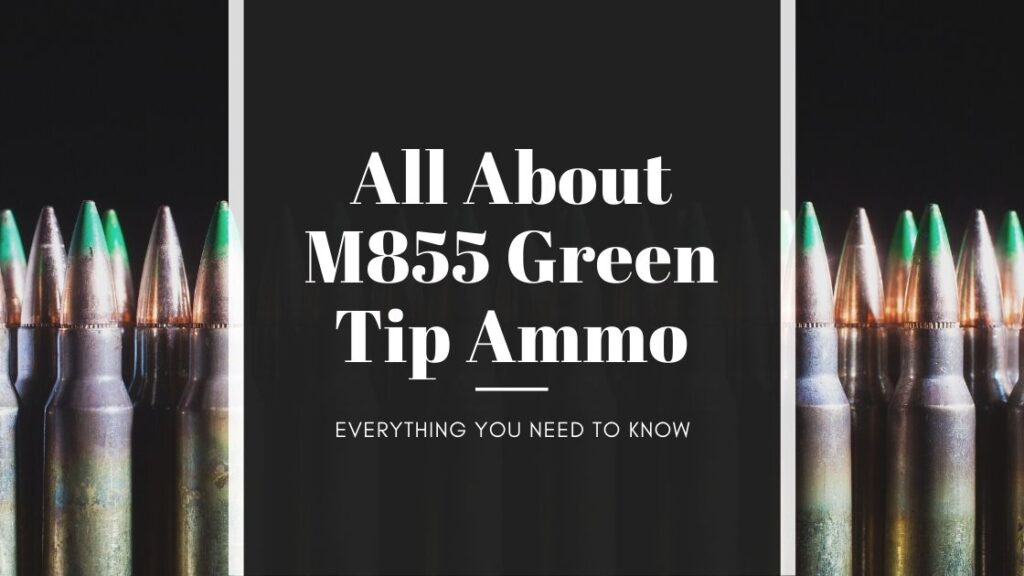
In this case, M855 is known as green tip 5.56 or similar things like green tip bullets. While the round does feature a green tip, it doesn’t tell us what the round is.
Developed in the 1970s, M855 is the US designation for the SS109. The SS109 is the standardized round of NATO and was developed out of a desire to extend the range of the FN Minimi machine gun.
After its adoption, M855 was used in machine guns and infantry rifles without the considerations for each platform. This would impact the performance of rifles like the M4 carbine. This performance issue came down to bullet design.
M855 is a classic rimless cartridge loaded with a composite-core projectile. The projectile is a spitzer-style bullet with a boat tail rear for better performance and features a copper jacket filled with a lead core and steel tip.
This steel tip is the major difference that sets green tip rounds apart from other 5.56 rounds. Let’s get into the ballistics of M855 green tip.
M855 Green Tip Ballistics
On average, M855 pushes a 62-grain 5.56 projectile at roughly 3,020 feet per second (fps). This is heavier than M193 with 7 grains of the weight being taken up by a steel “penetrator” at the tip.
This tip’s purpose was to allow the FN Minimi to be able to pierce steel helmets at distance. The actual requirements were the ability to pierce 3.5 mm of steel at 600 meters, and the tests were conducted on steel helmets.
While M855 passed that helmet penetrating requirement, it took away from the overall effectiveness of the round. Testing proved that green tip bullets did not perform well out of shorter barrels.
Many 5.56 rounds perform better out of longer barrel lengths, this is because the original round was optimized for a 20-inch barrel. However, many of those rounds will still perform adequately out of M4 barrel lengths. M855 on the other hand needed a longer barrel in order to perform well.
Due to the projectile’s construction and intended use, green tip 5.56 has a “sweet spot” of performance. While accurate shots with M855 can be made out to 500 meters this does not translate to terminal effectiveness.
This comes down to that steel tip.
Green tip 5.56 falls in the mid-range of 5.56 bullet weights at 62 grains. This helps it maintain some effectiveness at range, but it does not mean that the projectile will perform optimally.
Because of this extra weight and steel tip, 5.56 green tip tends to over-penetrate with less tumble/yaw when it does impact a target. This is problematic since most of its lethality comes from tumbling in a target.
It was found that M855 will only start to tumble at or beyond 4.7 inches of penetration. That means M855 starts tumbling as it exits or just before it exits a human torso, going from front to back. Changing the angle of impact can increase the amount of tissue the round has to go through but roughly 5 inches of penetration is a significant amount in a chest cavity.
Smaller frames and thinner bodies mean that the round will have even less effect than it had before. Combined with the drop-off in performance at 150 meters and you have a round that is only good at piercing steel helmets and light barriers.
This is not ideal when dealing with dangerous threats in a dynamic environment. The over-penetration of M855 can endanger people on the other side of your target. The bullet does not expand and does not tumble easily, making shot placement and multiple hits even more important when trying to achieve effective results.
But how does this compare to other rounds?
M855 vs M193
Green tip ammo is very popular due to its lower cost but it certainly is not the first 5.56 ammo. It is preceded by the M193 round. These two rounds are compared often because M193 is the standard 5.56 round
Let’s look at the basic differences between M855 and M193.
Bullet Differences
M855 and M193 differ in the dimensions and composition of their projectiles.
M855 projectiles are longer than M193 projectiles because of the steel tip. This requires faster twist rates in order to stabilize the round in flight.
The green tip projectile is also heavier by about 7 grains for a final weight of 62 grains compared to 55 grain M193.
These will impact each rounds’ performance.
Bullet Performance
The greatest difference between M855 and M193 is the performance of the projectiles.
Due to its greater weight and steel tip, M855 is better at defeating barriers. This can range from thin sheet metal to thicker clothing to brick. While it won’t necessarily defeat barriers like .30 caliber rounds, it will outperform M193.
However, vehicle glass presents a problem for M855. Bullets normally have a problem with windshields, veering off course after going through. M855 will sometimes defeat windshield glass or be completely hampered by it at closer ranges.
While outperformed in the realm of penetration, M193 provides multiple other benefits. The first is that M193 will work in a variety of twist rates. This means it’s easier to stabilize and won’t restrict you to certain barrel lengths or specific twist rates.
The second benefit is that M193 starts to fragment or tumble on impact at speeds as low as 2,700 fps. This is 300 feet slower than the average speed of M855, and the wounding abilities of M193 only increase with velocity.
M193 is also faster than M855, coming in at a 3,250 fps velocity. This is roughly 200 fps faster than M855.
All of this translates to a better effect on soft tissue but poorer performance when encountering barriers, brush, or certain kinds of steel when compared to M855.
Is Green Tip Ammo Legal?
The greatest controversy related to M855 is if it is legal or not. The answer is not a clear-cut “yes” or “no”, so let’s look at why there is a controversy.
Civilian access to armor-piercing ammunition in the US has been restricted for several decades which makes accessing it a grueling legal process. The controversy over M855 relates directly to if it is an armor-piercing round.
Many armor-piercing rounds feature a hardened steel penetrator in the bullet’s design. This helps defeat vehicular armor and body armor by punching through the material with a harder substance than lead.
Legally, armor-piercing ammunition is defined as having a core or projectile made of particularly dense materials or alloys and projectiles that feature a jacket that is over 25% of the bullet’s total weight. While the materials and alloys include steel or iron, what determines a core might be argued.
M855 was designed to pierce steel helmets. It was not designed as an armor-piercing round, unlike some variations of 7.62×51 and 5.45×39 which feature armor penetration as a major consideration.
M855 features a steel tip, which does add weight to the projectile but does not function as a proper penetrator core. It merely increases the effectiveness of the round at range on steel helmets. If the effect on steel helmets determined if a round was armor-piercing or not, then many standard .22 LR rounds would be armor-piercing.
But whether M855 is legal comes down to your local laws. Check with your local laws and a local legal expert before you purchase any ammunition you have legal questions about.
Some may cite that local indoor ranges do not allow M855 in many cases. Stating this means that the round is illegal. This is more of a business decision than a legal one. Because M855 can work on steel helmets and has better penetration than M193, it will damage steel targets and indoor backstops.
Indoor ranges don’t want to add any additional repair costs that might arise from people using M855, which is why it is not allowed on their ranges.
Conclusion
M855 is a good round for training, especially if you can pick it up cheaply. However, if you’re looking for ballistic performance, there are significantly better-designed rounds than M855.
Modern loadings can balance better effects on soft tissue and barriers than M855. For use in home defense and law enforcement, it is better to get a round designed for those intended roles. Green tips had a very narrow set of parameters that they met, but that does not make them a good general-use ammo type.
If you’re interested in more information on the different types of ammo and what they’re good for, be sure to subscribe to our newsletter and don’t miss a single issue.