
50 BMG Ammo
Shop in-stock .50 BMG ammunition — also written as .50 Browning Machine Gun, 12.7x99mm NATO, or simply 50 cal — with next-business-day shipping on most orders. Originally developed for heavy machine guns and still in active military service more than 100 years after its introduction, .50 BMG is the definitive extreme long-range cartridge for civilian precision shooters and one of the most powerful rifle cartridges legally available in the United States. If you’re feeding a Barrett M82, CheyTac, or any other .50 BMG platform, BulkMunitions stocks the rounds you need at competitive bulk prices.
-
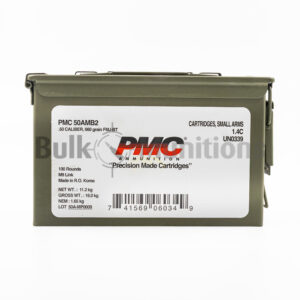
50 BMG – 660 gr FMJ – PMC (50A M/B) – Linked in M2A1 Ammo Can – 100 Rounds
$509.00$5.09 per round Add to cart -
-
-
About .50 BMG Ammo
Developed by John Browning in 1918 at the request of General John Pershing for an anti-aircraft and anti-vehicle heavy machine gun cartridge, .50 BMG has been in continuous military service longer than virtually any other cartridge in the world. It fires a .510-inch diameter bullet — most commonly a 647–750 grain projectile — at muzzle velocities of 2,750–2,950 fps, generating over 13,000 ft-lbs of muzzle energy. To put that in context, that is roughly five times the muzzle energy of .308 Winchester and more than twice that of .338 Lapua Magnum.
In civilian use, .50 BMG is chambered almost exclusively in single-shot bolt-action and semi-automatic anti-materiel rifles used for extreme long-range target shooting. The cartridge's exceptional ballistic performance — it stays supersonic past 2,000 yards and retains over 3,000 ft-lbs of energy at that distance — has made it the benchmark for ELR competition and long-range precision shooting at distances that no other practical production cartridge can match. Civilian ownership of .50 BMG rifles is legal in most U.S. states, though California bans the cartridge entirely and a handful of other states have restrictions.
What Is .50 BMG Best For?
- Extreme long-range target shooting: The primary civilian use case. .50 BMG is the dominant cartridge in ELR competition at distances of 1,500–2,000+ yards, where no other production cartridge delivers comparable retained energy and resistance to wind deflection.
- Long-range steel and precision rifle competition: The flat trajectory, high BC projectiles, and massive retained energy make .50 BMG uniquely satisfying for steel targets at distances that would be impossible with smaller calibers.
- Anti-materiel and barrier penetration: At ranges where other cartridges have exhausted their energy, .50 BMG continues to deliver. API (Armor Piercing Incendiary) and AP variants are restricted but standard ball loads will defeat light cover and vehicle glass at distances exceeding a mile.
- Collecting and military surplus shooting: Lake City and other military surplus .50 BMG is popular among collectors and shooters who appreciate the historical significance of the cartridge alongside its raw performance.
Bullet Types Available
- FMJ Ball (647–750gr): The standard range and training load. Lake City M33 Ball and similar military-specification loads are the most widely available and cost-effective option for high-volume .50 BMG shooting.
- Match / OTM (647–750gr): Precision loads optimized for extreme long-range accuracy. Hornady A-MAX and Lapua Bullex-N projectiles are the benchmarks for competitive ELR shooting. Match loads deliver meaningfully tighter groups at 1,000+ yards compared to standard ball.
- Tracer (M17/M21): Military-specification tracer loads for spotting impacts at extreme distances. Legal for civilian use in most states but subject to fire hazard restrictions in dry conditions.
- Pulled / Component Bullets: Pulled military surplus projectiles are popular among handloaders who want to reduce per-round cost. Available in ball, AP, and tracer configurations depending on current surplus availability.
Rifles Chambered in .50 BMG
.50 BMG requires a purpose-built, heavy rifle platform — it cannot be chambered in standard rifle actions. Common civilian platforms include the Barrett M82A1 and M107 semi-automatic, Barrett M95 and M99 bolt-action, McMillan TAC-50, Serbu BFG-50, Accuracy International AX50, Armalite AR-50, and Steyr HS .50. Most .50 BMG rifles weigh 25–35 lbs and are equipped with large muzzle brakes that are essential for managing recoil — without a brake, felt recoil from a .50 BMG rifle is severe enough to cause injury over extended shooting sessions.
One important legal note: .50 BMG is banned for civilian ownership in California. Maryland, Connecticut, and Hawaii have additional restrictions on .50 BMG rifles and ammunition. Always verify your state and local laws before purchasing.
Frequently Asked Questions
Is .50 BMG legal for civilians in the United States?
Yes, in most states. .50 BMG rifles and ammunition are legal for civilian ownership under federal law and in the majority of U.S. states. California bans .50 BMG entirely. Maryland, Connecticut, and Hawaii have additional restrictions. Always verify your specific state and local laws before purchasing.
What is the effective range of .50 BMG?
.50 BMG stays supersonic past 2,000 yards and retains over 3,000 ft-lbs of energy at that distance. Maximum effective range for precision fire against point targets is generally cited at around 1,800–2,000 yards for a trained shooter with quality equipment. Confirmed precision hits on steel beyond 2,500 yards have been recorded in competition. The limiting factor at extreme distances is typically the shooter, conditions, and optics — not the cartridge.
Can I shoot .50 BMG at a regular shooting range?
Most standard indoor and outdoor ranges do not permit .50 BMG due to extreme noise, muzzle blast, concussion, and range length requirements. You will typically need a dedicated long-range facility rated for the cartridge. Several specialty long-range ranges across the U.S. accommodate .50 BMG — contact your range directly before bringing the rifle.
How does .50 BMG compare to .338 Lapua Magnum?
.50 BMG produces roughly 2.5–3x the muzzle energy of .338 Lapua Magnum and delivers superior performance beyond 1,500 yards. .338 Lapua Magnum fits in a more manageable platform, costs significantly less per round, and is legal in all 50 states. For precision shooting inside 1,500 yards, .338 Lapua Magnum is the more practical choice. .50 BMG's advantages become dominant at distances beyond 1,500–2,000 yards where nothing else competes. They are not interchangeable.
How much does .50 BMG ammo cost per round?
Expect to pay roughly $3.50–$5.00/rd for standard FMJ ball and surplus loads and $6.00–$10.00+/rd for premium match-grade loads from Hornady or Lapua. As one of the most expensive centerfire cartridges in production, buying in bulk is the most effective way to reduce your per-round cost for range sessions.