In the modern world of defensive ammunition, we are familiar with rounds like 9mm and .45 ACP, but sometimes a new round will try and replace these rounds.
There’s nothing wrong with innovation, but sometimes a different round doesn’t always help us with our choices.
This brings us to .357 Sig. It is not a new round but it is definitely a more obscure round when compared to something like 9mm, .45 ACP, or even .40 S&W.
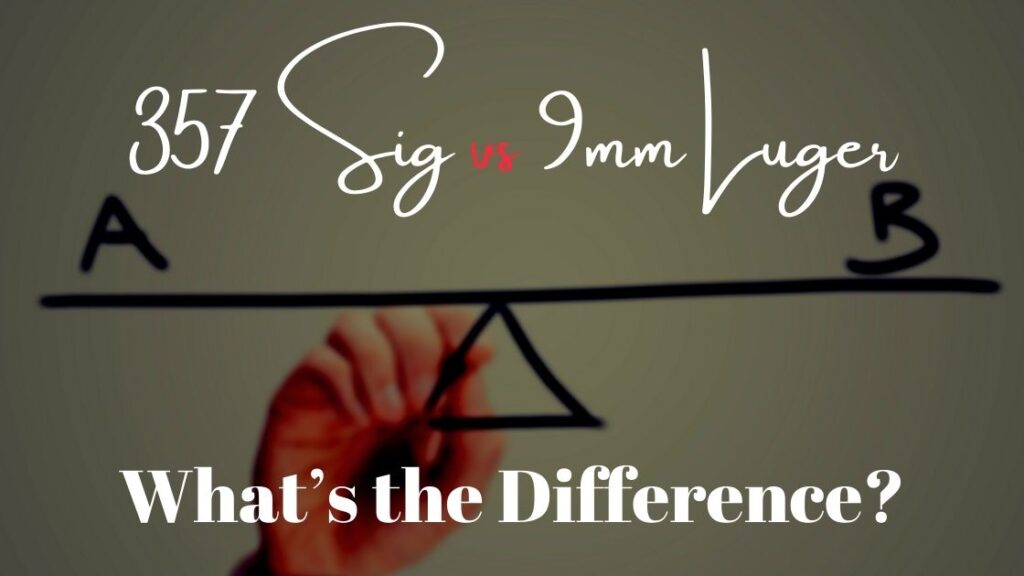
So what is .357 Sig and how does it compare to 9mm? Does it provide any benefits? Let’s find out.
.357 Sig vs 9mm: The Ultimate Comparison
These two rounds are somewhat similar, and since they are both offered in semi-automatic handguns, they are often considered for modern self-defense.
As with anything ammunition-related, there are advocates and detractors for both of these rounds. But we’re going to look at the ballistics of each of these rounds to understand if they are right for you.
In order to do that we have to know what .357 Sig is.
What is .357 Sig?
The .357 Sig is a bottle-necked handgun cartridge released in 1994 with the goal to achieve .357 Magnum performance in a semi-automatic handgun.
Bottle-necking a pistol cartridge is nothing new. The 7.62×25 Tokarev cartridge is one of the most famous examples of a bottle-necked pistol cartridge, but many of these general-issue designs stopped development after the 1960s.
Since .357 Sig was developed in the 1990s, it was one of the first bottlenecked cartridges to be developed for standard use in almost 30 years.
Due to the nature of bottle-necked cartridges, many of these designs have higher velocities than straight-walled or slightly tapered cartridges. The .357 Sig is no different.
The parent case used in the development of .357 Sig was 10mm. This was achieved by necking the case down to accept a 9mm projectile. Because of this, some .40 S&W pistols can be easily converted to .357 Sig.
What this boils down to is that .357 Sig attempts to mimic .357 Magnum, feeds more easily in magazine systems due to the bottle-necked design, and has a relatively high velocity for a pistol cartridge.
But how does it stack up to 9mm?
What’s the Difference? 9mm vs .357 Sig
A constant question in the firearms world is “which round is better?” In regards to 9mm and .357 Sig, this becomes an interesting question.
Both are technically 9mm and both are used in semi-automatic handguns. So what is the difference and which is better?
Due to the larger 10mm base case, .357 Sig has a lower capacity than 9mm. It also has more standardized bullet weights, with the most effective and popular rounds weighing 125 grains. The bullets are also designed to expand consistently at the slightly higher velocities .357 Sig puts out.
Since we’re dealing with handgun cartridges, we are only going to be encountering realistic barrel lengths of 4-6 inches in a concealed carry role using modern standards. This means we tend to have a velocity ceiling for both rounds. This also occurs when we compare 9mm vs .357 Magnum.
Longer barrel lengths with appropriate twist rates will increase the overall velocity of a round, but this does not always translate to better ballistic performance. This usually means that we are locked into a certain window of velocity and have to rely on bullet structure to expand our performance.
Most .357 Sig rounds have a base velocity similar to that of many 9mm +P rounds. This will vary between manufacturers and between what loadings we have for the cartridges themselves. The .357 Sig has rounds weighing from 60 grains to 147 grains, with most rounds being 125 grains.
The 9mm rounds on the other hand have a much wider variety of options. Projectiles ranging from 50 grains to 147 grains are provided by a number of manufacturers. The most common loads are 115, 124, and 147-grain projectiles.
Each of these cartridges has different energy and velocity. To better understand which each offers we’re going to look at some of the ballistics of 9mm vs .357 Sig.
.357 Sig vs 9mm Ballistics
There are over 40 different loadings for .357 Sig, which seems like a lot until we realize that 9mm has over 200 different loads.
Now many of these loads are going to perform similarly since some of the major variations are only related to the manufacturer. But it is unfair to compare a round with 5 times the variations than another. So we are going to take some of the lightest, heaviest, and average loads to compare.
We’ll be measuring the velocity in feet-per-second (fps) and the energy in foot-pounds (ft-lbs).
| Round | Bullet weight | Velocity | Energy |
| Bouble Tap .357 Sig JHP | 147 grains | 1250 fps | 510 ft-lbs |
| Federal 9mm +P HST | 147 grains | 1050 fps | 360 ft-lbs |
| Federal 9mm HST | 147 grains | 1000 fps | 326 ft-lbs |
| Underwood .357 Sig Gold Dot HP | 125 grains | 1450 fps | 584 ft-lbs |
| Federal 9mm +P Tactical HST | 124 grains | 1200 fps | 396 ft-lbs |
| Federal 9mm Hydro-Shok | 124 grains | 1120 fps | 345 ft-lbs |
| RBCD .357 Sig TFSP | 60 grains | 2410 fps | 774 ft-lbs |
| Magsafe 9mm | 50 grains | 2000 fps | 444 ft-lbs |
As you can see .357 Sig has roughly 200-400 fps more than 9mm. It also has consistently higher energy, roughly 100-300 ft-lbs more than 9mm. But does this translate to lethality?
9mm v .357 Sig “Stopping Power”
Stopping power is a very inaccurate term when used with ballistics. It began to be used in the late 1800s and early 1900s to describe how effective projectiles were at stopping an opponent. However, most of the evidence used to support stopping power was anecdotal evidence.
Today a better term to use would be “Effectiveness” or “Lethality”. So what is the effectiveness of these two rounds?
Both of these rounds are handgun rounds. Even when pushed to their maximum effective velocity they pale in comparison to proper rifle rounds. This is because rifle rounds have a higher velocity, properly made projectiles for that velocity, and generally longer barrel lengths.
We have to realize that handguns rely on shot placement more than rifle rounds do. This means shots to the central nervous system or other major organs are going to get us the result we need.
In order to create a greater margin of error for the end-user, it is best to use modern hollow points. These rounds will expand, creating a bigger wound channel when compared to full-metal- jacket ball ammunition.
Some independent testers have done significant research comparing different self-defense rounds with each other. In their findings, .357 Sig vs 9mm ballistics were not all that different.
The .357 Sig has a penetration range of 13.2 inches to 19.7 inches depending on the load. The average velocities of those rounds ranged from 1,369 fps to 1,423 fps. And the average expansion of the rounds ranged from .58 inches to .69 inches.
For 9mm the average penetration range was 13.4 inches to 18.3 inches. The average velocity ranged from 941 fps to 1,170 fps. And the average expansion ranged from .52 inches to .74 inches.
This brings us to how each round performs in the gun itself.
Recoil: Which is Better?
The recoil of .357 Sig is similar to .40 S&W. But they are not equal, .357 Sig has a lighter recoil than .40 S&W. When compared to 9mm both have heavier recoils.
This means that the .357 Sig is moderately more controllable than .40 S&W but not 9mm. This affects the speed of follow-up shots which impacts how well they may be used defensively.
Cost and Availability
The cost of .357 Sig is more than both 9mm and .40 S&W. Usually .357 Sig is double the price of 9mm. For .40 S&W this price difference is about a 50% increase in price. This definitely makes it harder to practice using .357 Sig, with some using .40 S&W for their training round and .357 Sig for their carry round.
However, there is one benefit to .357 Sig. Since it is not considered a popular round it is less likely to be impacted by shortages. Rounds like 9mm and .45 ACP are some of the first to go during a panic-buying period.
This makes .357 Sig a potential alternative to have on hand if there are no other available rounds.
9mm vs .357 Sig for Self Defense: Which Wins?
Clearly, .357 Sig has more energy and higher velocities than 9mm. The numbers clearly show this. But how a round should perform on paper does not always translate to the real world and it doesn’t take into account all the factors of self-defense.
Independent testing has shown that overall expansion, which adds to the effectiveness of the round, leans more in favor of 9mm. The .357 Sig doesn’t offer any greater benefit there.
It offers higher velocity and a more consistent velocity across a number of loadings. This velocity also makes it better for longer distances with a flatter trajectory. But this velocity comes at the cost of wearing out the gun faster.
In terms of penetration, .357 Sig had the most overall. But this is not necessarily a good thing. Over penetration can create additional hazards. These hazards include shoot-through incidents where someone on the other side of an attacker is hit with a round. This is problematic when we want to limit collateral damage.
A pistol round that will penetrate deeply enough to affect the major organs and the central nervous system, but not so much as to go completely through the target is better from the perspective of lessening collateral damage.
On top of this .357 Sig has a lower capacity and higher recoil than 9mm. Having more ammunition and being able to keep the gun on target better will lead to better results. This is because we have more ammunition to expend and an easier time controlling the gun to get more accuracy.
However, .357 sig does have a potential benefit that 9mm does not have. Since .357 produces a louder gunshot and more muzzle flash there is a potential of a psychological stop on an opponent.
Humans and animals do not like loud noise accompanied by sudden bright light. This means the greater muzzle flash and report might impact an aggressor’s behavior resulting in them giving up.
This psychological response should not be relied on but it is a factor to consider.
In terms of overall self-defense, 9mm provides more benefits than .357 Sig. If the round had become more popular and better refined, the .357 Sig might have overtaken 9mm. However, the real-world testing shows that whatever perceived benefits .357 Sig has do not fully translate to being better than 9mm.
9mm vs .357 Sig: Which is Better?
Which round is better is very subjective. Both can be used effectively in a self-defense scenario if the shooter knows what they are doing.
However, 9mm is better in terms of less wear on the gun and typically cheaper ammunition which translates to more live-fire practice and longer use of the gun. While .357 Sig is better protected from shortages, it does impact how long your handgun will last in the long term.
Higher velocities mean that the gun will wear out faster than one chambered in 9mm. Combined with the greater capacity, better controllability, a wider variety of ammunition, and the larger number of firearms chambered in it, make 9mm the better choice than .357 Sig.
Does this mean you shouldn’t get a .357 Sig? No. But choosing a defensive handgun goes beyond caliber. We have to make sure our supply chain and our training can be supported with the caliber we choose.
In an ideal world, we would have both rounds at our disposal, but the added cost of maintaining multiple types of ammunition can make this problematic.
This really comes down to which round you prefer and how much you are willing to spend in developing the skill to use it.