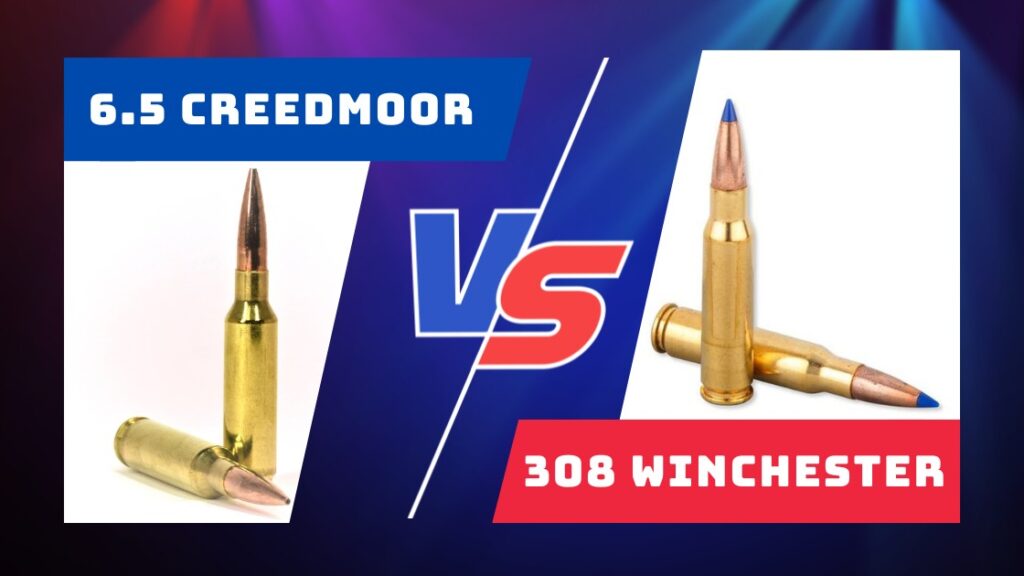
6.5 Creedmoor and 308 Winchester are two of the most popular centerfire rifle cartridges in America, and they compete for the same shooters. Both fit short-action rifles, both are accurate, and both will take deer with the right bullet. But they get there in very different ways. 308 fires a heavier .30-caliber bullet with more energy up close. 6.5 Creedmoor fires a long, slippery 6.5mm bullet that holds its velocity better, drifts less in the wind, and kicks noticeably less.
This guide compares the two side by side, with a ballistics chart out to 1,000 yards, recoil numbers, hunting and long-range performance, barrel life, ammo cost, and a simple way to decide which one belongs in your safe.
6.5 Creedmoor vs 308: The Quick Answer
- Choose 6.5 Creedmoor if you want to shoot long range, compete, or hunt deer-sized game with less recoil. It drifts less in the wind and drops less past 500 yards.
- Choose 308 Winchester if you want cheaper, more widely available ammo, heavier bullets for larger game, longer barrel life, or a semi-auto battle rifle like the M1A or an AR-10.
- Inside 400 yards, the practical difference for most shooters is small. Past 600 yards, 6.5 Creedmoor’s advantage grows quickly.
6.5 Creedmoor vs 308 at a Glance
| 6.5 Creedmoor | 308 Winchester | |
|---|---|---|
| Introduced | 2007 (Hornady) | 1952 (Winchester) |
| Parent case | .30 Thompson/Center | Commercial version of the T65 military cartridge |
| Bullet diameter | .264 in (6.5mm) | .308 in (7.62mm) |
| Case length | 1.920 in | 2.015 in |
| Action length | Short action | Short action |
| Common bullet weights | 120 to 147 grains | 147 to 180 grains |
| Typical match load | 140gr at about 2,710 fps | 168gr at about 2,700 fps |
| Muzzle energy (typical match load) | About 2,280 ft-lbs | About 2,720 ft-lbs |
| Calculated free recoil (9 lb rifle) | About 10 ft-lbs | About 14 ft-lbs |
| Military use | Limited (U.S. SOCOM sniper rifles) | Widespread as 7.62×51 NATO |
Where Each Cartridge Came From
308 Winchester
Winchester introduced 308 Winchester in 1952 as a commercial version of the experimental T65 cartridge the U.S. military was developing to replace 30-06 Springfield. The military version was standardized in 1954 as 7.62×51 NATO. Because it delivers nearly 30-06 performance in a shorter case, 308 became one of the most popular hunting and target cartridges in the world, and it remains a standard chambering in almost every bolt-action and semi-auto rifle line.
308 Winchester and 7.62×51 NATO are closely related but not identical. If you shoot military surplus ammo, read our guide to 308 Winchester ammo for the differences.
6.5 Creedmoor
Hornady introduced 6.5 Creedmoor in 2007. It was designed by Hornady’s Dave Emary and long-range competitor Dennis DeMille as a match cartridge that could fire long, high-ballistic-coefficient 6.5mm bullets from a short action, with factory ammo accurate enough to win matches. It was built on the .30 Thompson/Center case, which is itself derived from 308 Winchester.
6.5 Creedmoor caught on with precision rifle competitors in the 2010s, then spread to hunters. Today it is chambered in nearly every bolt-action line on the market, and U.S. special operations units have adopted it for some sniper rifles.
Cartridge Size and Rifle Compatibility
The two cartridges are close relatives. Both share the same rim and base diameter, both fit short-action rifles, and in many rifles a barrel swap is the main difference between the two. Many bolt-action rifles and AR-10 style rifles use the same magazines for both.
The differences are in the case and bullet. 6.5 Creedmoor has a slightly shorter case with a sharper 30-degree shoulder, which leaves room to seat long, heavy-for-caliber bullets without cutting into powder space. 308 has a longer case and a larger .308-inch bullet.
They are not interchangeable. Never fire 6.5 Creedmoor in a 308 rifle or 308 in a 6.5 Creedmoor rifle. Always match the ammunition to the caliber marked on the barrel.
6.5 Creedmoor vs 308 Ballistics Chart
The chart below compares two popular match loads with similar muzzle velocities: a 140-grain 6.5 Creedmoor bullet and a 168-grain 308 bullet. Both are zeroed at 100 yards with a 10 mph full-value crosswind.
| Range (yards) | 6.5 CM Drop (in) | 308 Drop (in) | 6.5 CM Wind Drift (in) | 308 Wind Drift (in) | 6.5 CM Velocity (fps) | 308 Velocity (fps) |
|---|---|---|---|---|---|---|
| 100 | 0 | 0 | 0.5 | 0.7 | 2,569 | 2,527 |
| 200 | -3.8 | -4.0 | 2.2 | 2.7 | 2,432 | 2,360 |
| 300 | -13.4 | -14.2 | 5.0 | 6.3 | 2,300 | 2,200 |
| 400 | -29.7 | -31.5 | 9.2 | 11.7 | 2,172 | 2,046 |
| 500 | -53.3 | -57.3 | 14.7 | 18.9 | 2,047 | 1,898 |
| 600 | -85.2 | -92.6 | 21.8 | 28.3 | 1,927 | 1,758 |
| 700 | -126.5 | -139.3 | 30.6 | 40.0 | 1,812 | 1,625 |
| 800 | -178.3 | -199.1 | 41.2 | 54.2 | 1,701 | 1,502 |
| 900 | -242.3 | -274.4 | 53.8 | 71.2 | 1,596 | 1,388 |
| 1,000 | -319.8 | -367.8 | 68.4 | 91.2 | 1,497 | 1,286 |
Calculated using published Hornady figures: 6.5 Creedmoor 140gr ELD Match at 2,710 fps (G1 BC .646) and 308 Winchester 168gr ELD Match at 2,700 fps (G1 BC .523), 1.5-inch sight height, standard atmosphere. Your rifle, barrel length, and conditions will change these numbers, so always confirm your own dope at the range.
Two things stand out. First, drop is nearly identical out to about 400 yards. Second, wind drift is where 6.5 Creedmoor pulls away. At 500 yards the 6.5 drifts about 20 percent less, and at 1,000 yards it drifts about 23 inches less in the same wind. Wind is the hardest variable to read at long range, so that margin forgives mistakes.
6.5 Creedmoor vs 308 at Long Range
Long-range performance comes down to ballistic coefficient (BC), which measures how well a bullet resists air drag. 6.5mm bullets are long and narrow for their weight, so they have a high BC. The 140-grain ELD Match has a G1 BC of .646, compared with .523 for the 168-grain 308 ELD Match.
308 vs 6.5 Creedmoor at 1,000 Yards
At 1,000 yards, the 6.5 Creedmoor load in the chart is still traveling about 1,500 fps, comfortably supersonic. The 308 load is down to about 1,290 fps and approaching the transonic zone, where air turbulence around the speed of sound can upset a bullet and hurt accuracy. The 6.5 also drops about 48 inches less.
That is the main reason 6.5 Creedmoor took over precision rifle competition. 308 can absolutely hit at 1,000 yards, and it did for decades, but it demands more precise wind calls. Heavier, higher-BC 308 bullets like the 175 and 178-grain match loads close part of the gap, at the cost of more recoil.
For a broader look at long-range cartridges, see The Best Long Range Caliber for Any Situation.
Which Recoils Harder?
308 recoils harder. Using typical match loads in a 9-pound rifle, we calculate free recoil at about 10 ft-lbs for 6.5 Creedmoor and about 14 ft-lbs for 308, roughly 25 to 30 percent less for the Creedmoor.
That difference matters more than the numbers suggest. Less recoil makes it easier to stay in the scope and spot your own hits, makes long practice sessions more comfortable, and helps newer shooters avoid developing a flinch. For youth and smaller-framed hunters, 6.5 Creedmoor is often the easier cartridge to shoot well. Rifle weight, stock design, and a muzzle brake or suppressor all change felt recoil for either cartridge.
6.5 Creedmoor vs 308 for Hunting
Both cartridges are excellent deer cartridges. The right choice depends on the size of the game and the distance.
- Deer, pronghorn, and hogs: Both work very well. 6.5 Creedmoor’s flatter trajectory and lower recoil make it a favorite for open-country deer and pronghorn. 308 hits harder at close and medium range.
- Elk and larger game: 308 has the edge, especially with 165 to 180-grain bonded or monolithic bullets that drive deep. 6.5 Creedmoor can take elk with premium bullets and good shot placement at moderate range, but it leaves less margin for error.
- Brush and timber: 308’s heavier bullets are slightly more forgiving, though no rifle bullet reliably “busts brush.”
Bullet construction matters as much as the cartridge. Match bullets are designed for accuracy, not controlled expansion, so use a hunting bullet such as a soft point, bonded, or polymer-tipped hunting design. Always check your state’s hunting regulations for minimum caliber or energy requirements.
Barrel Life: 6.5 Creedmoor vs 308
308 barrels generally last much longer. Shooters commonly report 5,000 to 10,000 or more accurate rounds from a 308 match barrel, depending on how hot the barrel gets and how much accuracy you require. 6.5 Creedmoor burns a similar amount of powder through a smaller bore, so it wears the throat faster. Precision shooters commonly report around 2,500 to 3,500 rounds of match-grade accuracy before a rebarrel.
For a hunter shooting a few boxes a year, barrel life is not a real concern with either cartridge. For a competitor shooting thousands of rounds a year, 308’s longer barrel life is a real cost savings.
Ammo Cost and Availability
308 Winchester is generally cheaper and easier to find. Because 7.62×51 NATO has been a military cartridge for decades, there is a large supply of affordable FMJ and range ammo, plus hunting and match loads from nearly every manufacturer. That makes 308 easier to shoot in volume.
6.5 Creedmoor ammo is widely available today, but most of it is match or hunting ammunition, so the cheapest practice ammo usually costs more per round than 308 FMJ. Buying by the case narrows the gap. Shop in-stock 308 ammo and 6.5 Creedmoor ammo to compare current options.
What Is the Difference Between 308 and 7.62×51 NATO?
308 Winchester and 7.62×51 NATO share the same external dimensions, and most modern 308 rifles fire both. The differences are in how they are made and measured. Military 7.62×51 brass is often slightly thicker, and the two cartridges are pressure-tested with different methods, so their published pressure limits are not directly comparable. Chamber headspace specifications also differ slightly.
In practice, a modern rifle chambered for 308 Winchester will safely fire commercial 7.62×51 NATO, and a rifle chambered for 7.62×51 will fire 308. The exceptions are older military rifles and some converted surplus rifles, where you should check the manufacturer’s guidance or have a gunsmith confirm headspace. There is no 7.62×51 equivalent for 6.5 Creedmoor, which is one reason 308 has a deeper supply of affordable range ammo.
Best Ammo Types for Each Use
| Use | 6.5 Creedmoor | 308 Winchester |
|---|---|---|
| Range practice and plinking | 120 to 140gr FMJ or OTM | 147 to 150gr FMJ or 7.62×51 ball |
| Long-range target and competition | 140 to 147gr match (ELD Match, Berger Hybrid) | 168 to 178gr match (Sierra MatchKing, ELD Match) |
| Deer and pronghorn | 129 to 143gr expanding hunting bullets | 150 to 165gr soft point or polymer tip |
| Elk and large game | 140 to 156gr bonded or monolithic, at moderate range | 165 to 180gr bonded or monolithic |
| Hogs | Bonded or monolithic hunting bullets | 150 to 180gr soft point or bonded |
Whatever you choose, sight in and practice with the same load you plan to hunt or compete with. Different bullet weights and designs often hit at different points of impact, even from the same rifle.
Reloading 6.5 Creedmoor vs 308
Both cartridges are popular with reloaders, and both use boxer-primed brass that is widely available. Most 308 and 6.5 Creedmoor brass uses large rifle primers, but some manufacturers now offer 6.5 Creedmoor brass with small rifle primer pockets, so check your brass before you load.
308 has the deepest selection of bullets, powders, and published load data of almost any rifle cartridge. 6.5 Creedmoor has an excellent selection of high-BC match and hunting bullets. If you shoot high volume and reload, 308’s longer barrel life and cheaper components can make it the more economical choice over time.
Rifle Options
Both cartridges are offered in nearly every major bolt-action line, including the Ruger American, Tikka T3x, Savage 110, Bergara, Browning X-Bolt, and Ruger Precision Rifle. Where 308 pulls ahead is semi-autos and military-style rifles. If you want an M1A, AR-10 pattern rifle, FN SCAR 17, or a classic battle rifle, 308 and 7.62×51 offer far more choices. 6.5 Creedmoor semi-autos exist in the AR-10 platform, but the selection is smaller.
Common Myths About 6.5 Creedmoor and 308
“6.5 Creedmoor is just a fad.”
6.5 Creedmoor has been on the market since 2007 and is now chambered in nearly every major bolt-action line, used by competitive shooters, and adopted for some U.S. special operations sniper rifles. Its popularity rests on real ballistic advantages, not marketing alone.
“308 is obsolete.”
308 Winchester remains one of the most versatile cartridges ever made. It has a huge selection of affordable ammo, works in bolt-actions and semi-autos alike, takes most North American big game, and still wins at 1,000 yards in skilled hands. Newer cartridges have narrowed its advantages, not erased them.
“6.5 Creedmoor hits harder because it shoots flatter.”
Not at typical hunting ranges. 308 starts with more energy, and the two stay close through the middle ranges. 6.5 Creedmoor’s advantage is that it holds velocity better, so it retains more energy than the 308 load in our chart only past about 600 yards. At 300 yards the 308 load still carries more energy.
“You need a magnum for long range.”
Plenty of shooters ring steel at 1,000 yards with 6.5 Creedmoor and 308. Magnums like 300 Win Mag and 6.5 PRC extend range and reduce wind drift further, but they bring more recoil, more expensive ammo, and shorter barrel life. For most shooters, a well-built 6.5 Creedmoor or 308 rifle and plenty of practice will do more for long-range hits than a bigger cartridge. For a closer look at the step up, see 6.5 PRC vs 6.5 Creedmoor.
Practical Differences at the Range
Shoot both cartridges side by side and a few things become obvious. The 6.5 Creedmoor is easier to spot your own impacts with, because the rifle settles back faster after the shot. That matters for correcting misses at long range without a spotter. The 308 rewards a firm, consistent hold and a heavier rifle or brake for the same reason.
Ammo selection feels different, too. With 308, you can practice cheaply with FMJ, then switch to match or hunting ammo, but expect a point-of-impact shift between loads. With 6.5 Creedmoor, many shooters simply practice with the same match load they compete or hunt with, which keeps their data consistent. Either way, record your drop and wind data for the exact load you shoot, because published charts are only a starting point.
Which Should You Buy?
| If you mainly want to… | Choose |
|---|---|
| Shoot steel at 600 to 1,000+ yards or compete in PRS-style matches | 6.5 Creedmoor |
| Hunt deer and pronghorn in open country with low recoil | 6.5 Creedmoor |
| Hunt elk, moose, or large hogs at practical ranges | 308 Winchester |
| Shoot high volume as cheaply as possible | 308 Winchester |
| Own a semi-auto battle rifle or AR-10 | 308 Winchester |
| Start a new or smaller-framed shooter on a centerfire rifle | 6.5 Creedmoor |
| Get maximum barrel life | 308 Winchester |
If you are torn, think about how far you will realistically shoot. Most hunting shots happen inside 300 yards, where either cartridge does the job. If you plan to stretch past 600 yards regularly, 6.5 Creedmoor is the better tool. If you want the most versatile, affordable, and widely supported cartridge, 308 is hard to beat. If you want even more speed than 6.5 Creedmoor, look at 6.5 PRC, which needs a longer action and recoils more.
Frequently Asked Questions
Is 6.5 Creedmoor better than 308?
6.5 Creedmoor is better at long range, with less wind drift, less drop past 500 yards, and less recoil. 308 is better for larger game at practical ranges, cheaper practice ammo, longer barrel life, and semi-auto rifle options. Neither is better for every shooter.
Does 6.5 Creedmoor have less recoil than 308?
Yes. With typical match loads in a 9-pound rifle, 6.5 Creedmoor produces about 10 ft-lbs of free recoil compared with about 14 ft-lbs for 308, roughly 25 to 30 percent less.
Can I shoot 308 in a 6.5 Creedmoor rifle?
No. 6.5 Creedmoor and 308 Winchester use different bullet diameters and case dimensions. Only fire ammunition that matches the caliber marked on your barrel.
Is 6.5 Creedmoor good for elk?
6.5 Creedmoor can take elk with premium hunting bullets and careful shot placement at moderate range, but it leaves less margin for error than 308 or larger cartridges. Many elk hunters prefer 308 or a magnum cartridge with heavier bullets.
Which is cheaper to shoot, 6.5 Creedmoor or 308?
308 is usually cheaper to shoot because of the large supply of FMJ range ammo and military-style 7.62×51 loads. Most 6.5 Creedmoor ammo is match or hunting ammunition, which costs more per round.
The Bottom Line
6.5 Creedmoor and 308 Winchester are both proven, accurate short-action cartridges. 6.5 Creedmoor wins on long-range ballistics and recoil. 308 wins on versatility, ammo cost, barrel life, and rifle selection. Pick the one that matches how and where you actually shoot, then buy enough ammo to practice with it. Shop in-stock 6.5 Creedmoor ammo and 308 Winchester ammo with next-business-day shipping from our Knoxville, TN warehouse.