
9mm Ammo
-
-
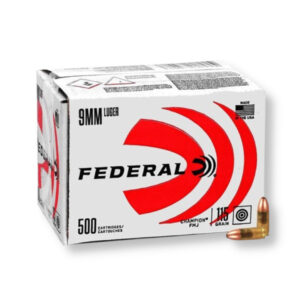
9mm – 115 gr FMJ – Federal Champion (C9115A500) – 500 Rounds Bulk Pack
$149.00$0.30 per round Add to cart -
-
-
-

-
-
-
-
-
-
-
-
-
-
-
-
-

-
SALE
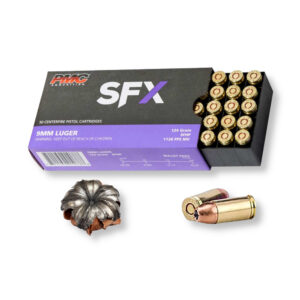
9mm – 124 gr SFX JHP – PMC (9SFX) – 50 Rounds
Save $4.01 Original price was: $34.00.$29.99$0.60 per roundCurrent price is: $29.99. Add to cart -
-

-
-
Overview of 9mm Ammo
Whether you call it 9mm Luger, 9mm Parabellum, or just 9mm, 9x19mm is the most widely used centerfire pistol cartridge in the world. Introduced by Georg Luger in 1902 and later standardized by NATO, it is the most common law enforcement and military pistol cartridge worldwide and is chambered in more handguns than any other caliber. Manageable recoil, high magazine capacity, and near-universal availability make it the default choice for most shooters. Most 9mm handguns are effective out to about 50 yards, though defensive shooting typically happens inside 10.
Modern 9mm hollow points have improved significantly. Following its 2014 ammunition evaluation, the FBI concluded that quality 9mm JHP loads perform comparably to larger calibers like .40 S&W while offering more capacity and faster follow-up shots. Not sure which load fits your use? See our guide to hollow point bullets.
Popular 9mm Brands We Carry
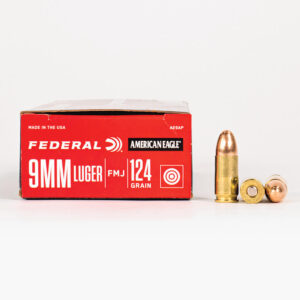
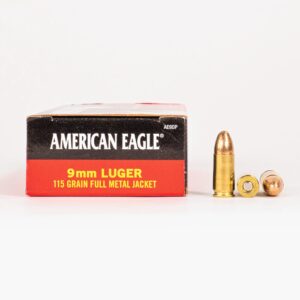
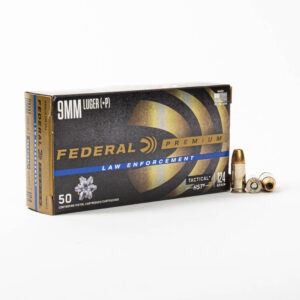
- Federal 9mm Ammo: Federal HST 124 gr and 147 gr JHP, among the most widely carried defensive loads in law enforcement, plus American Eagle FMJ for range use.
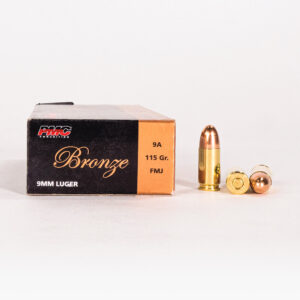
- PMC 9mm Ammo: Brass-case FMJ at one of the lowest per-round prices we carry.
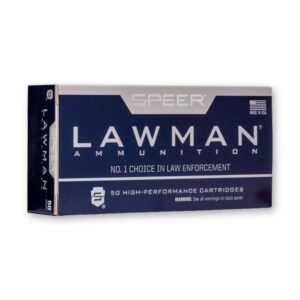
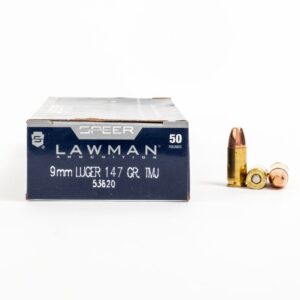
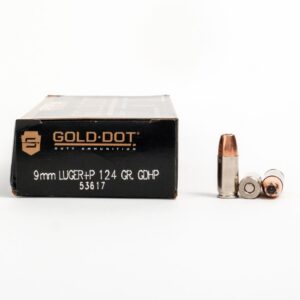
- Speer 9mm Ammo: Gold Dot 124 gr and 147 gr JHP, a law enforcement standard for decades, and Lawman TMJ for matched training.
- Hornady 9mm Ammo: Critical Duty 135 gr FlexLock and Critical Defense FTX.
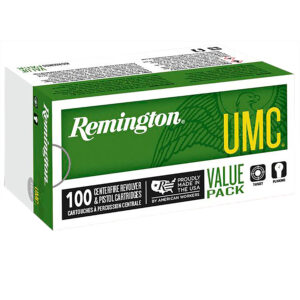
- Remington 9mm Ammo: UMC 115 gr and 124 gr FMJ in 500 and 1,000-round cases.
- Winchester 9mm Ammo: USA White Box FMJ and PDX1 Defender JHP.
- Black Hills 9mm Ammo: +P 115 gr JHP and the HoneyBadger 125 gr Subsonic.
Best 9mm Ammo for Specific Uses
| Use Case | Top Pick | Also Consider |
|---|---|---|
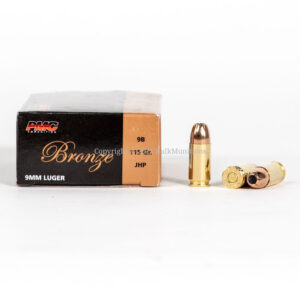
| Range / High-Volume Training | PMC Bronze 115 gr FMJ, 1,000 Rounds | Federal American Eagle 115 gr FMJ, Blazer Brass 115 gr FMJ |
| Concealed Carry / Self-Defense | Federal HST 147 gr JHP | Speer Gold Dot 147 gr JHP, Hornady Critical Duty 135 gr +P |
| Compact / Short-Barrel Pistols | Speer Gold Dot 147 gr JHP | Federal HST 147 gr, Hornady Critical Defense 115 gr FTX |
| Suppressed / Subsonic | Black Hills HoneyBadger 125 gr Subsonic | Blazer Brass 147 gr FMJ, PMC 147 gr FMJ |
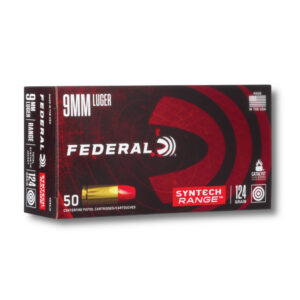
| Competition / USPSA | Federal Syntech 124 gr TSJ | Speer Lawman 124 gr TMJ, PMC Bronze 124 gr FMJ |
How to Choose 9mm Ammo
Start with how you will use it. That one decision narrows down bullet type, grain weight, and case material.
Bullet type. Full metal jacket (FMJ) is the standard for range practice. It feeds reliably and costs the least. Jacketed hollow point (JHP) bullets are built to expand on impact, which makes them the standard for carry and home defense. For indoor ranges and steel targets, Total Metal Jacket (TMJ) and Total Synthetic Jacket (TSJ) bullets reduce lead exposure and splash-back.
Grain weight. 9mm is most often loaded in three weights. 115 gr is the lightest and fastest, with a snappy feel, and is the most common range load. 124 gr is the NATO standard weight and a balanced choice for both practice and carry. 147 gr is the heaviest common weight. It is subsonic in most loads, pairs well with suppressors, and many shooters find its recoil softer. Practicing with the same weight you carry keeps your point of aim consistent.
Case material. Brass is the most common case. It extracts smoothly, resists corrosion, and is reloadable. Steel and aluminum cases cost less per round and work well in most modern pistols, but they cannot be reloaded, and many indoor ranges do not allow steel-case ammo. Check your range's policy before buying steel case by the thousand.
Pressure rating. +P ammunition and 9mm NATO are loaded to higher pressure than standard 9mm for added velocity. Most modern pistols are rated for them, but your owner's manual has the final word. If it does not approve +P, stick with standard-pressure loads.
What Our Customers Say
Shooters have left more than 750 verified reviews on our 9mm ammunition, with an average rating of 4.9 out of 5 stars. Here are a few that speak to the ammo itself.
"PMC Bronze 9mm 115gr FMJ (9A) 1000 round bulk has consistently been a good price point through Bulk Munitions and shot w/o any issues for 3000 rounds and counting. On par with Fiocchi, IMI and other factory FMJ."
MP, 5 stars, verified buyer, on PMC Bronze 115 gr FMJ
"This Federal Premium 147 HST is my GO TO round for self defense. Has always cycled and will go exactly where you aim."
Jeff, 5 stars, verified buyer, on Federal HST 147 gr JHP
"My 1911 double stack Nighthawk and Race City Defense pistols are precise pistols and tuned to 124 gr loads and I shoot them a lot, maybe 500 rounds per week... The Lawman ammunition has been perfect for about 3,000 rounds and I believe I have cut down my cleaning time significantly."
David B., 5 stars, verified buyer, on Speer Lawman 124 gr TMJ
Why Buy 9mm Ammo from BulkMunitions?
- In stock and ready to ship. We only list ammunition that is physically in our warehouse. No backorders.
- Next-business-day shipping from our Knoxville, TN warehouse on orders placed before our daily cutoff.
- Bulk pricing on top brands. The more you buy, the lower your cost per round. Case quantities deliver the best per-round price on every load we carry.
- We tithe 10% of profits to Christian-based, 2A-supporting organizations every quarter, and our customers vote on where it goes.
Frequently Asked Questions
What is the best 9mm ammo for concealed carry?
Federal HST 147 gr and Speer Gold Dot 147 gr are among the most widely recommended 9mm carry loads, with consistent penetration and expansion in FBI-protocol gel testing. For short-barrel pistols, the 147 gr weight tends to perform more consistently at reduced velocity than lighter loads. Whatever you choose, test it in your own pistol for reliable feeding before carrying it.
Should I buy 115, 124, or 147 grain 9mm?
All three are reliable. 115 gr is the most common and affordable range load. 124 gr is the NATO weight and a balanced choice for practice and carry. 147 gr is subsonic in most loads, works well with suppressors, and many shooters find its recoil softer. The best approach is to practice with the same weight you carry.
What is the difference between FMJ and JHP 9mm ammo?
FMJ (full metal jacket) bullets have a solid, enclosed nose. They feed reliably and cost less, which makes them the standard for range practice. JHP (jacketed hollow point) bullets have an open nose designed to expand on impact, which makes them the standard for carry and home defense. Many shooters train with FMJ and carry JHP, after confirming their pistol feeds the JHP reliably.
Is steel case or aluminum case 9mm ammo okay to use?
Steel and aluminum case 9mm works in most modern pistols and costs less per round than brass, which makes it popular for high-volume practice. The tradeoffs are that it cannot be reloaded and many indoor ranges do not allow steel-case ammo. Brass remains the most versatile choice.
What is the difference between 9mm Luger, 9mm NATO, and 9mm Parabellum?
9mm Luger, 9mm Parabellum, and 9x19mm are the same cartridge. 9mm NATO uses the same case but is loaded to higher pressure, similar to +P. Most modern 9mm pistols handle NATO-spec ammunition, but check your manufacturer's specifications before shooting it regularly, especially in older or lightweight pistols.
Do all 9mm bullets fit all 9mm guns?
No. 9mm Luger (9x19mm) is by far the most common, but several other cartridges also use a "9mm" name and are not interchangeable: 9mm Makarov (9x18mm), .380 ACP (sometimes labeled 9mm Kurz or 9mm Short), and 9x21mm. Most modern 9mm pistols are chambered for 9mm Luger. Check the marking on your barrel or slide before buying.
Does it matter what 9mm ammo I buy?
Yes, depending on use. For range practice, any quality FMJ from a reputable manufacturer works in most pistols. For self-defense, use a proven JHP load and confirm your pistol feeds it reliably before carrying it. Also check that your pistol is rated before shooting +P or NATO-spec ammunition, and that your range allows steel-case ammo if you buy it.
Is 9mm or .40 S&W better for self-defense?
Following its 2014 evaluation, the FBI concluded that modern 9mm JHP loads perform comparably to .40 S&W with less recoil, more capacity, and lower cost. Many agencies, including the FBI, have since moved to 9mm. Both remain capable defensive cartridges, and the right choice is the one you shoot accurately.
What 9mm ammo is best for a suppressor?
Subsonic 147 gr loads are the usual choice because they stay below the speed of sound, which avoids the supersonic crack and maximizes suppression. Black Hills HoneyBadger 125 gr Subsonic, Blazer Brass 147 gr FMJ, and PMC 147 gr FMJ are all good options. Confirm your pistol cycles reliably with heavier, slower loads.
Is 9mm ammo reloadable?
Brass-case 9mm with Boxer primers is reloadable, which covers most brands we carry, including PMC, Federal, Blazer Brass, Speer, and Winchester. Steel and aluminum cases are not designed to be reloaded. Factory-new 9mm sold today is non-corrosive.
More About 9mm Ammo
Georg Luger developed the 9x19mm cartridge for his Luger pistol, and it was introduced by the German arms maker DWM in 1902. The name Parabellum comes from DWM's Latin motto, "Si vis pacem, para bellum," meaning "If you want peace, prepare for war." The German Navy adopted the cartridge in 1904 and the German Army in 1908, and it served in both World Wars.
After World War II, 9mm spread across Europe and became NATO's standard pistol cartridge. The U.S. military adopted it in 1985 with the Beretta M9, replacing the .45 ACP M1911 that had served since 1911. The Army's current service pistol, the SIG Sauer M17 and M18, remains chambered in 9mm.
In the U.S. civilian and law enforcement market, 9mm lost ground to .40 S&W through the 1990s and 2000s, when many agencies doubted its terminal performance. Improved hollow point designs and the FBI's 2014 return to 9mm reversed that trend. Today, 9mm is the best-selling handgun caliber in the country, which keeps ammunition widely available and makes it the most economical centerfire pistol cartridge to shoot in volume.