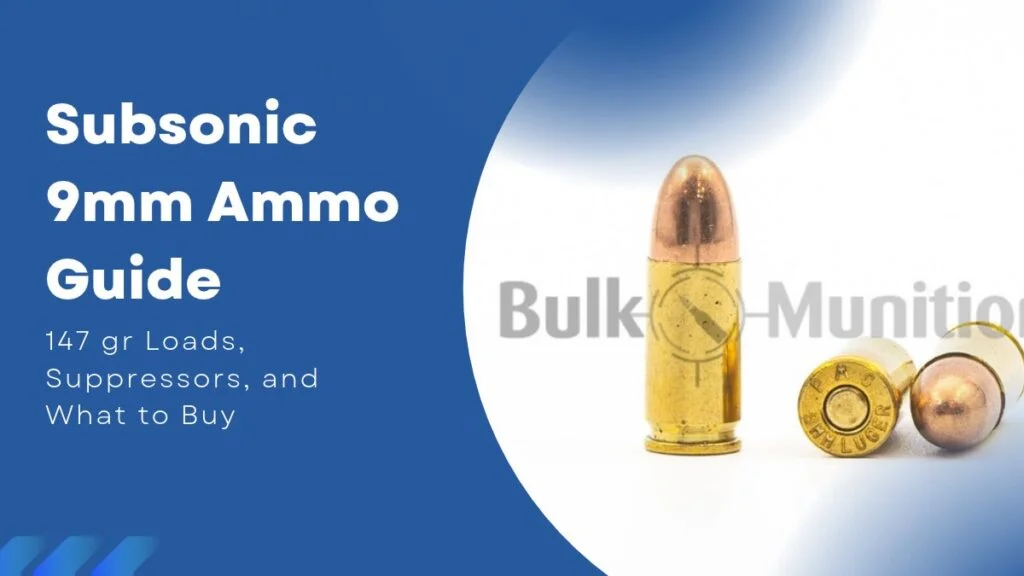
Subsonic 9mm ammo is one of the most searched topics in handgun shooting, mostly because of suppressors. But subsonic loads are not just for cans. Many shooters like their softer, push-style recoil, and some of the most popular self-defense loads in the country are subsonic.
This guide explains what makes 9mm ammo subsonic, how it compares to standard 115 and 124 grain loads, which guns it works best in, and how to pick the right box.
Short answer: Subsonic 9mm stays below the speed of sound, about 1,125 feet per second at sea level, so it does not make a supersonic crack. Most subsonic 9mm uses heavy 147 grain bullets at around 950 to 1,000 fps. It is the best choice for suppressed shooting and works well for practice and self-defense.
What Does Subsonic Mean?
The speed of sound is about 1,125 fps at sea level on a 59 degree day. It changes with temperature: it is a little slower in cold air and a little faster in hot air. A bullet traveling faster than that creates a small sonic boom, the sharp crack you hear downrange. A subsonic bullet stays below that line, so the only noise is the muzzle blast and the action cycling.
That is why subsonic ammo matters so much with a suppressor. A suppressor can reduce muzzle blast, but it cannot do anything about a supersonic crack. Keep the bullet subsonic and a suppressed 9mm becomes far quieter.
Subsonic vs Standard 9mm Loads
| Load | Typical velocity | Muzzle energy | Subsonic? |
|---|---|---|---|
| 115 gr FMJ | About 1,150 to 1,200 fps | About 340 to 370 ft-lbs | No |
| 124 gr FMJ | About 1,100 to 1,150 fps | About 335 to 365 ft-lbs | Borderline, usually no |
| 147 gr FMJ or JHP | About 950 to 1,000 fps | About 295 to 325 ft-lbs | Yes |
| Specialty subsonic loads | Under 1,050 fps | Varies by bullet | Yes, by design |
Velocities are typical factory figures from pistol-length barrels and vary by load, barrel length and temperature. Energy is calculated from the listed bullet weight and velocity.
The 147 grain bullet is the standard for subsonic 9mm. Its extra weight lets it carry similar momentum at a lower speed, which keeps it below the sound barrier while still cycling most pistols reliably.
Pistol vs Carbine Barrels
Barrel length changes velocity. A 147 grain load that is safely subsonic from a 4 inch pistol barrel can pick up speed from a 16 inch pistol caliber carbine and get close to, or in some cases above, the speed of sound. If you are shooting a suppressed PCC, look for loads that are rated subsonic from a carbine barrel, or test with a chronograph.
Why Shooters Choose Subsonic 9mm
- Suppressor use: no supersonic crack means much quieter shooting.
- Softer recoil feel: many shooters describe the recoil of 147 grain loads as a slower push rather than a sharp snap.
- Less muzzle blast indoors: helpful at indoor ranges and for home defense, though it is still loud without hearing protection.
- Self-defense: many top defensive loads, such as 147 grain Federal HST, Speer Gold Dot and Hornady XTP, are subsonic and designed to expand and penetrate to FBI test standards.
Downsides to Know
- Cycling: some pistols with heavy recoil springs, or a suppressor without a booster, may not cycle every subsonic load reliably. Test before you rely on it.
- Point of impact: heavier, slower bullets often hit a little higher than 115 grain loads at handgun distances. Check your zero.
- Trajectory: slower bullets drop more at long range, though that rarely matters at typical pistol distances.
- Cost: some specialty subsonic loads cost more than standard 115 grain range ammo.
Popular Subsonic 9mm Loads
| Load | Type | Best for |
|---|---|---|
| Blazer Brass 147 gr FMJ | Range FMJ | Low-cost suppressed practice |
| PMC 147 gr SFX JHP | Hollow point | Defense and suppressed training |
| Hornady 147 gr XTP | Hollow point | Defense, controlled expansion |
| Black Hills HoneyBadger 125 gr Subsonic | Solid copper, fluted | Suppressed defense, deep penetration |
| Federal HST 147 gr | Hollow point | Duty and concealed carry |
Cost per Round
| Subsonic load (in stock) | Price per round |
|---|---|
| Blazer Brass 147 gr FMJ, 1,000 rounds | About $0.35 |
| PMC 147 gr SFX JHP, 1,000 rounds | About $0.50 |
| Hornady 147 gr XTP, 250 rounds | About $1.04 |
| Black Hills HoneyBadger 125 gr Subsonic, 500 rounds | About $1.72 |
Prices are BulkMunitions in-stock prices at the time of writing (November 2026) and change often. Check the category page for current pricing.
Buying 147 grain FMJ by the case is an affordable way to practice with the same recoil and point of impact as your 147 grain carry ammo.
How to Pick the Right Subsonic 9mm
- Suppressed range shooting: 147 gr FMJ in bulk.
- Suppressed PCC: a load rated subsonic from a 16 inch barrel, and confirm with a chronograph.
- Concealed carry or home defense: a proven 147 gr JHP, and practice with matching 147 gr FMJ.
- Reliability first: run at least a few hundred rounds of your chosen load through your gun before trusting it.
Shop 9mm ammo in bulk, including 147 grain subsonic loads.
FAQ
Is 147 grain 9mm always subsonic?
From most pistols, yes. From longer carbine barrels, some 147 grain loads can approach or exceed the speed of sound. Check the box or use a chronograph.
Do I need subsonic ammo for a suppressor?
No, but it makes a big difference. Supersonic ammo will still produce a crack even through a suppressor.
Is subsonic 9mm good for self-defense?
Yes. Many of the most trusted defensive loads are 147 grain subsonic hollow points designed to expand and penetrate reliably.
Is subsonic 9mm quiet without a suppressor?
No. It removes the supersonic crack, but the muzzle blast is still loud. Always wear hearing protection.
Why does my pistol not cycle subsonic ammo?
Heavy recoil springs, a suppressor without a booster, or a very light load can cause short-stroking. Try a different load or ask your pistol’s maker about spring options.
Does subsonic ammo hit in a different spot?
Often a little higher than 115 grain loads at handgun distances. Confirm your zero with your carry load.