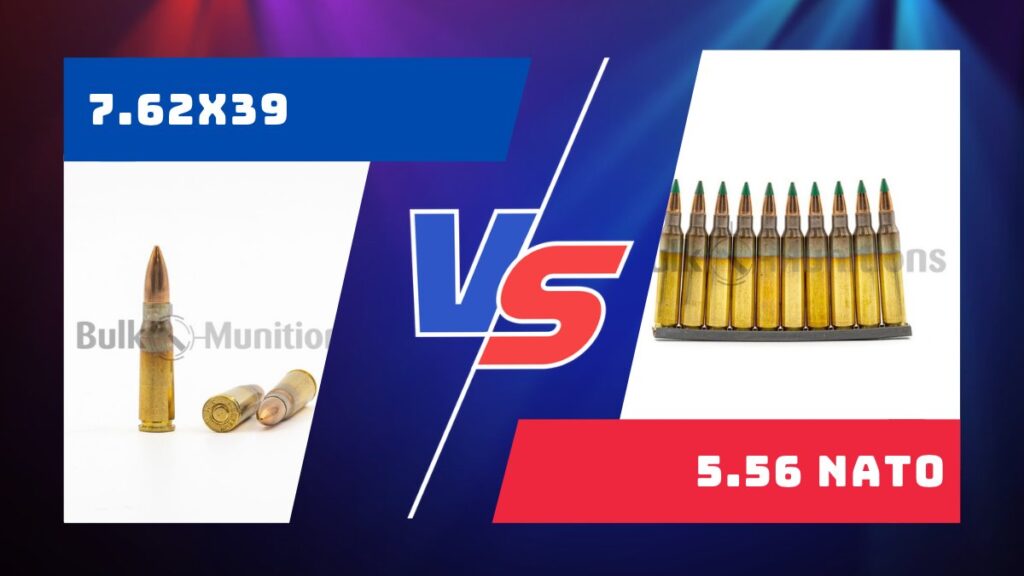
The 7.62x39mm and the 5.56x45mm NATO are the two most common military-style rifle cartridges on the planet. One is the round of the AK-47. The other is the round of the AR-15 and M4. Both have huge followings, and both are inexpensive and easy to find, but they were designed around very different ideas.
The 7.62×39 fires a heavier bullet at moderate speed. The 5.56 fires a light bullet very fast. That shapes everything from trajectory and recoil to how much ammo you can carry. Here is a full comparison.
Short answer: Choose 5.56 for an AR-15, longer shots, lighter recoil and carrying more ammo. Choose 7.62×39 for an AK or SKS, shorter-range use, and very low-cost range ammo.
7.62×39 vs 5.56 at a Glance
| 7.62x39mm | 5.56x45mm NATO | |
|---|---|---|
| Introduced | 1940s (Soviet Union) | 1960s (U.S.) |
| Bullet diameter | .311 to .312 in | .224 in |
| Case length | 1.524 in | 1.760 in |
| Common bullet weights | 122 to 125 gr | 55 to 77 gr |
| Typical velocity | About 2,350 fps (16 in) | About 3,000 to 3,200 fps (16 to 20 in) |
| Typical muzzle energy | About 1,500 ft-lbs | About 1,250 to 1,300 ft-lbs |
| Practical range | Up to about 300 yards | Up to about 500 yards |
| Recoil | Moderate | Light |
| Approx. weight per round | Heavier (about 16 to 18 g) | Lighter (about 12 g) |
History
The Soviet Union developed the 7.62×39 during World War II as an intermediate cartridge: less powerful than a full-size rifle round, but more effective than a pistol round. It was first used in the SKS and then became the cartridge of the AK-47 and AKM, two of the most produced rifles in history.
The 5.56 traces back to the .223 Remington and the AR-15 developed in the late 1950s. The U.S. military adopted it with the M16 in the 1960s, and NATO standardized it in the 1980s. Its light weight and flat trajectory made it the standard for many armies, and the AR-15 made it America’s most popular rifle cartridge.
Ballistics and Trajectory
| Load | Velocity | Muzzle energy |
|---|---|---|
| 7.62×39 123 gr FMJ (16 in) | About 2,350 fps | About 1,510 ft-lbs |
| 5.56 55 gr M193 (20 in) | About 3,240 fps | About 1,280 ft-lbs |
| 5.56 62 gr M855 (20 in) | About 3,000 fps | About 1,240 ft-lbs |
Ballistic figures are typical factory numbers for common loads. Your results will vary with the exact load, barrel length and conditions. Energy is calculated from the listed bullet weight and velocity.
The 7.62×39 starts with a bit more energy, but its heavier, slower bullet drops faster. Zeroed for 100 yards, a typical 7.62×39 load drops noticeably more than 5.56 by 300 yards, which makes range estimation more important. The 5.56 shoots much flatter, which makes hits easier at longer, unknown distances.
In short: inside about 200 yards, both are effective. Past 300 yards, 5.56 has a clear edge in hitting what you aim at.
Terminal Performance and Barriers
The heavier 7.62×39 bullet tends to hold its path better through light brush and some barriers. The 5.56 relies on velocity and bullet design. Modern 5.56 loads, from soft points to bonded and barrier-blind bullets, perform very well for defense and hunting varmints and predators. For deer, many hunters prefer heavier, expanding 7.62×39 or heavier-for-caliber 5.56 hunting loads where legal.
Recoil
The 5.56 has very light recoil, which makes fast follow-up shots and long range sessions easy. 7.62×39 recoil is still mild compared to full-power rifles, but noticeably more than 5.56, especially in lighter rifles.
Weight and Capacity
A 5.56 round weighs roughly a third less than a 7.62×39 round. That means you can carry significantly more ammo for the same weight. Standard magazines hold 30 rounds for both.
Rifles and Platforms
7.62×39
- AK-47, AKM and AK-pattern rifles
- SKS
- Ruger Mini-30
- CZ 527 and other bolt guns
- AR-15s with a 7.62×39 upper, bolt and magazines
5.56 NATO
- AR-15, M4-style carbines and countless variants
- Ruger Mini-14
- FN SCAR 16, Tavor and other modern rifles
- Bolt actions chambered in .223 Wylde or 5.56
Note on 5.56 vs .223: rifles chambered in 5.56 NATO can safely fire .223 Remington. Firing 5.56 in a rifle chambered only for .223 can create excessive pressure. Check your barrel stamp.
Accuracy
A typical AR-15 in 5.56 will usually group tighter than a typical AK in 7.62×39, partly because of the rifles and partly because of ammo quality. Good AKs with quality ammo can shoot well, but the AR platform and wide availability of match 5.56 ammo give it an edge.
Cost per Round
| 7.62×39 | 5.56 NATO | |
|---|---|---|
| Lowest price per round in stock | About $0.69 | About $0.52 |
| Typical range | $0.69 to $1.37 | $0.52 to $1.90 |
Prices are BulkMunitions in-stock prices at the time of writing (November 2026) and change often. Check the category page for current pricing.
Steel-cased 7.62×39 has long been one of the cheapest centerfire rifle rounds, but brass-cased 5.56 bought in bulk is often just as affordable and is reloadable.
Pros and Cons
7.62×39
- Pro: heavier bullet, slightly more energy up close
- Pro: better through light brush
- Pro: works in rugged AK and SKS rifles
- Pro: low-cost steel-cased ammo
- Con: more drop past 200 to 300 yards
- Con: heavier to carry
5.56 NATO
- Pro: flat trajectory and longer practical range
- Pro: very light recoil
- Pro: lighter ammo, carry more
- Pro: huge selection of rifles and loads
- Con: lighter bullet is more affected by brush
- Con: some hunting restrictions on .22 caliber centerfire for deer
Which Should You Choose?
- Your rifle is an AR-15: 5.56.
- Your rifle is an AK or SKS: 7.62×39.
- Longer shots, open country: 5.56.
- Brush and short range hog hunting: 7.62×39 with soft points.
- Home defense: either with proper defensive loads. 5.56 is easier to shoot fast.
- High-volume training: both are affordable in bulk.
Shop 5.56 ammo or 7.62×39 ammo in bulk.
FAQ
Which is more powerful, 7.62×39 or 5.56?
The 7.62×39 has a bit more energy at the muzzle with common loads. The 5.56 is faster and flatter, and keeps its advantage at longer distances.
Which is more accurate?
In general, AR-15s in 5.56 group tighter than typical AKs in 7.62×39, though the rifle and ammo matter a lot.
Can I shoot 7.62×39 in an AR-15?
Only with a 7.62×39 barrel, bolt and dedicated magazines.
Which is better for deer?
Where legal, 7.62×39 with soft points is generally considered better suited to deer than standard 5.56 loads. Some states restrict .22 caliber centerfire rounds for deer.
Which is better for home defense?
Both can work with proper defensive ammo. The 5.56’s lighter recoil makes fast, accurate shots easier.
Is 5.56 the same as .223?
Very similar, but 5.56 is loaded to higher pressure. 5.56 rifles can fire .223, but not always the other way around.
Which ammo is cheaper?
Steel-cased 7.62×39 is often the cheapest per round, but bulk brass 5.56 is close and reloadable.