
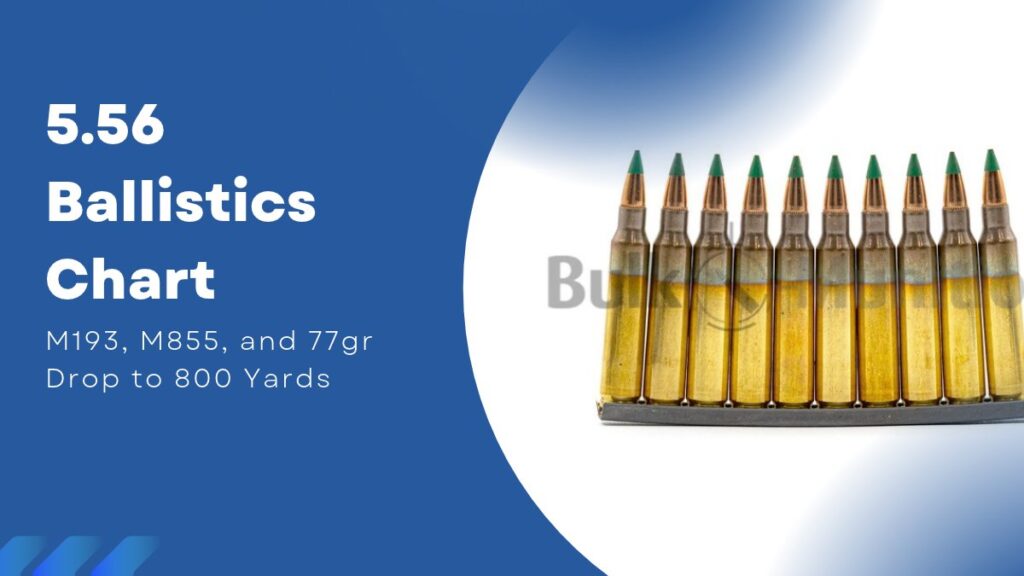
5.56 NATO is one of the most-shot centerfire rifle rounds in America, and most of it goes downrange as 55gr M193 or 62gr M855. This 5.56 ballistics chart shows velocity, energy, bullet drop, and wind drift out to 800 yards for those two loads and a 77gr match load, plus scope adjustments, a 50-yard zero table, and point-blank range.
Every number on this page was calculated from the manufacturers’ own published muzzle velocity and ballistic coefficient. Use it to compare loads and plan your holds, then confirm them with your own rifle.
5.56 Ballistics at a Glance
- Muzzle velocity: about 2,750 to 3,120 fps with 55 to 77 grain loads.
- Drop at 300 yards (100-yard zero): about 10.6 to 12.7 inches.
- Drop at 500 yards (100-yard zero): about 57 to 59 inches.
- Wind drift at 500 yards (10 mph): about 28 to 41 inches.
- Supersonic range: about 650 to 850 yards.
Loads in This 5.56 Ballistics Chart
- 55gr M193: PMC X-TAC 55gr FMJ-BT M193 (5.56X), 3,120 fps, G1 BC 0.243
- 62gr M855: PMC X-TAC 62gr M855 green tip (5.56K), 2,920 fps, G1 BC 0.304
- 77gr OTM: Black Hills 77gr OTM (D556N9), 2,750 fps, G1 BC 0.372
Browse current 5.56 ammo to see which of these loads and others are in stock.
5.56 Ballistics Chart to 800 Yards
Velocity (fps)
| Range | 55gr M193 | 62gr M855 | 77gr OTM |
|---|---|---|---|
| Muzzle | 3,120 | 2,920 | 2,750 |
| 100 yd | 2,718 | 2,611 | 2,505 |
| 200 yd | 2,353 | 2,322 | 2,274 |
| 300 yd | 2,017 | 2,053 | 2,055 |
| 400 yd | 1,710 | 1,803 | 1,849 |
| 500 yd | 1,443 | 1,576 | 1,657 |
| 600 yd | 1,227 | 1,376 | 1,483 |
| 700 yd | 1,076 | 1,212 | 1,329 |
| 800 yd | 979 | 1,090 | 1,201 |
Energy (ft-lbs)
| Range | 55gr M193 | 62gr M855 | 77gr OTM |
|---|---|---|---|
| Muzzle | 1,189 | 1,174 | 1,293 |
| 100 yd | 902 | 938 | 1,073 |
| 200 yd | 676 | 742 | 884 |
| 300 yd | 497 | 580 | 722 |
| 400 yd | 357 | 448 | 584 |
| 500 yd | 254 | 342 | 469 |
| 600 yd | 184 | 261 | 376 |
| 700 yd | 141 | 202 | 302 |
| 800 yd | 117 | 164 | 246 |
Bullet Drop (inches, 100-yard zero)
| Range | 55gr M193 | 62gr M855 | 77gr OTM |
|---|---|---|---|
| Muzzle | -2.6 | -2.6 | -2.6 |
| 100 yd | 0 | 0 | 0 |
| 200 yd | -2.2 | -2.5 | -3.0 |
| 300 yd | -10.6 | -11.5 | -12.7 |
| 400 yd | -27.8 | -28.9 | -30.7 |
| 500 yd | -56.9 | -56.9 | -58.9 |
| 600 yd | -102.8 | -99.1 | -99.8 |
| 700 yd | -172.0 | -159.7 | -156.6 |
| 800 yd | -271.0 | -244.1 | -233.0 |
Wind Drift (inches, 10 mph crosswind)
| Range | 55gr M193 | 62gr M855 | 77gr OTM |
|---|---|---|---|
| Muzzle | 0 | 0 | 0 |
| 100 yd | 1.2 | 1.1 | 0.9 |
| 200 yd | 5.2 | 4.4 | 3.9 |
| 300 yd | 12.5 | 10.5 | 9.1 |
| 400 yd | 24.0 | 19.9 | 17.0 |
| 500 yd | 40.8 | 33.1 | 28.0 |
| 600 yd | 63.6 | 51.0 | 42.5 |
| 700 yd | 92.9 | 73.9 | 60.9 |
| 800 yd | 127.5 | 101.9 | 83.6 |
How we calculated these numbers: each manufacturer’s published muzzle velocity and G1 ballistic coefficient, standard atmosphere (59°F, sea level), 2.6-inch (typical AR-15 optic) sight height, and a 10 mph full-value crosswind for wind drift. Spin drift is not included. Velocities come from manufacturer test barrels, so a shorter barrel, higher altitude, or different temperature will change your results. Always confirm your own data at the range before shooting at distance.
M193 is the fastest out of the barrel, but its light, short bullet loses speed quickly. By 500 yards the 77gr OTM is moving about 1,657 fps versus about 1,443 fps for M193. The 77gr bullet catches both lighter loads in velocity by about 300 yards and carries the most energy at every distance.
5.56 Scope Adjustments (MOA and Mils)
These tables convert the drop numbers above into elevation corrections for a rifle zeroed at 100 yards. Dial up the number shown, or hold over that amount on your reticle.
Elevation in MOA (100-yard zero)
| Range | 55gr M193 | 62gr M855 | 77gr OTM |
|---|---|---|---|
| 200 yd | 1.0 | 1.2 | 1.4 |
| 300 yd | 3.4 | 3.7 | 4.0 |
| 400 yd | 6.6 | 6.9 | 7.3 |
| 500 yd | 10.9 | 10.9 | 11.2 |
| 600 yd | 16.4 | 15.8 | 15.9 |
| 700 yd | 23.5 | 21.8 | 21.4 |
| 800 yd | 32.4 | 29.1 | 27.8 |
Elevation in Mils (100-yard zero)
| Range | 55gr M193 | 62gr M855 | 77gr OTM |
|---|---|---|---|
| 200 yd | 0.3 | 0.4 | 0.4 |
| 300 yd | 1.0 | 1.1 | 1.2 |
| 400 yd | 1.9 | 2.0 | 2.1 |
| 500 yd | 3.2 | 3.2 | 3.3 |
| 600 yd | 4.8 | 4.6 | 4.6 |
| 700 yd | 6.8 | 6.3 | 6.2 |
| 800 yd | 9.4 | 8.5 | 8.1 |
5.56 Drop With a 50-Yard Zero
The 50-yard zero (often called a 50/200 zero) is the most popular AR-15 zero because the bullet crosses back through the line of sight near 200 yards. That keeps your hits close to point of aim for most practical distances.
Bullet Drop (inches, 50-yard zero)
| Range | 55gr M193 | 62gr M855 | 77gr OTM |
|---|---|---|---|
| Muzzle | -2.6 | -2.6 | -2.6 |
| 50 yd | 0 | 0 | 0 |
| 100 yd | +1.6 | +1.5 | +1.3 |
| 150 yd | +1.9 | +1.6 | +1.3 |
| 200 yd | +1.0 | +0.4 | -0.3 |
| 250 yd | -1.6 | -2.5 | -3.6 |
| 300 yd | -6.0 | -7.2 | -8.7 |
| 350 yd | -12.5 | -14.0 | -15.9 |
| 400 yd | -21.6 | -23.1 | -25.4 |
| 450 yd | -33.6 | -34.8 | -37.4 |
| 500 yd | -49.1 | -49.7 | -52.2 |
Maximum Point-Blank Range
Maximum point-blank range is the farthest distance you can hold dead on a target of a given size without the bullet rising above or falling below it. A 4-inch zone suits coyotes and other varmints; 6 inches is common for deer where 5.56 is legal.
| Load | Zero (4″ target) | Point-blank range (4″) | Zero (6″ target) | Point-blank range (6″) |
|---|---|---|---|---|
| 55gr M193 | 50 yd | 255 yd | 240 yd | 280 yd |
| 62gr M855 | 210 yd | 240 yd | 240 yd | 275 yd |
| 77gr OTM | 210 yd | 240 yd | 240 yd | 275 yd |
For M193, the classic 50-yard zero is also the best 4-inch zero, which is a big part of why it is so popular on AR-15s.
Energy and Supersonic Range
5.56 is a light, fast round, so energy drops off quickly. The heavier 77gr bullet keeps more of what it starts with.
| Load | Muzzle energy | Energy at 300 yd | Energy at 500 yd | Supersonic to |
|---|---|---|---|---|
| 55gr M193 | 1,189 ft-lbs | 497 ft-lbs | 254 ft-lbs | about 650 yd |
| 62gr M855 | 1,174 ft-lbs | 580 ft-lbs | 342 ft-lbs | about 750 yd |
| 77gr OTM | 1,293 ft-lbs | 722 ft-lbs | 469 ft-lbs | about 850 yd |
5.56 vs 300 Blackout Ballistics
The AR-15’s two most common chamberings behave very differently. With a 100-yard zero, M855 drops about 12 inches at 300 yards while a 150gr 300 Blackout FMJ drops about 33 inches. The 300 Blackout carries more energy at every distance, but the 5.56 is far easier to hit with past 200 yards. See the 300 Blackout ballistics chart and 300 Blackout vs 5.56 for the full picture, read 5.56 vs .223 before you mix them, or compare it with the AK round in 7.62×39 vs 5.56.
What Changes Your 5.56 Ballistics
- Barrel length. Published 5.56 velocities usually come from 20-inch barrels. A 16-inch carbine is slower, and a 10.5 or 11.5 inch barrel is slower still, which adds drop and wind drift.
- Twist rate. Heavy bullets like the 77gr OTM need a fast twist (1:8 or 1:7) to stabilize. A 1:9 barrel may not stabilize them.
- Sight height. These tables use 2.6 inches, typical of an AR-15 with an optic. A different mount changes the numbers inside 200 yards.
- Your actual velocity. A chronograph reading from your own rifle is the single best upgrade to any ballistics chart.
Frequently Asked Questions
How far does 5.56 drop at 300 yards?
With a 100-yard zero and an AR-15 sight height, common 5.56 loads drop about 10.6 to 12.7 inches at 300 yards.
How far does 5.56 drop at 500 yards?
With a 100-yard zero, 55gr M193, 62gr M855, and 77gr OTM all drop about 57 to 59 inches at 500 yards. The heavier 77gr bullet starts slower but catches up because it holds its speed better.
What is a 50/200 zero for 5.56?
It means zeroing at 50 yards so the bullet crosses the line of sight again near 200 yards. With a 2.6-inch sight height, M193 zeroed at 50 yards prints about +1.6 inches at 100 yards and +1.0 at 200 yards, so it stays within about 2 inches of your aim from 25 to roughly 250 yards.
Which 5.56 load is best past 500 yards?
The 77gr OTM. By our calculations it stays supersonic to about 850 yards, compared with about 750 for M855 and 650 for M193, and it drifts about 21 inches less than M193 at 600 yards in a 10 mph wind.
Is M855 flatter than M193?
Not inside 500 yards. M193 starts faster and drops slightly less out to about 400 yards, the two are nearly identical at 500 yards (about 57 inches each with a 100-yard zero), and M855’s higher BC gives it the edge beyond that.
The Bottom Line
For practice and plinking inside 300 yards, M193 and M855 shoot nearly the same, so buy whichever is cheaper per round. For 500 yards and beyond, a 77gr match load is the clear upgrade. Shop bulk 5.56 ammo to stock up on both.