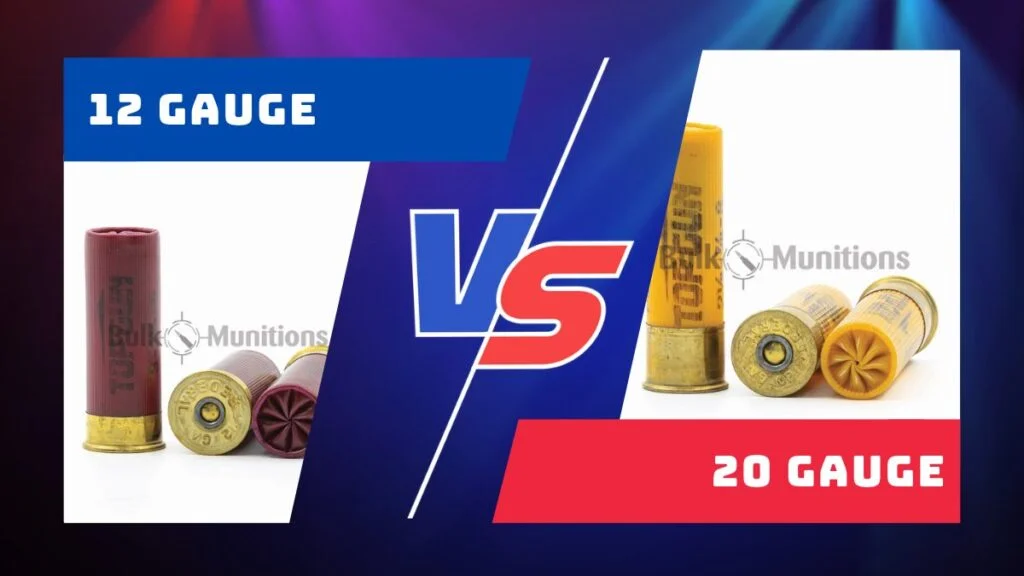
The 12 gauge and the 20 gauge are the two most popular shotgun sizes in America by a wide margin. Walk into any gun store and most of the shotguns on the wall will be one or the other. The 12 gauge is the do-everything workhorse. The 20 gauge is lighter, softer shooting and a favorite of upland hunters and newer shooters.
Here is how they compare on power, recoil, patterns, uses and cost, so you can pick the right one.
Short answer: Choose a 12 gauge if you want one shotgun for everything, including home defense, waterfowl and turkey. Choose a 20 gauge if you want a lighter gun with less recoil for upland birds, clays, small game, youth or smaller shooters.
12 Gauge vs 20 Gauge at a Glance
| 12 Gauge | 20 Gauge | |
|---|---|---|
| Bore diameter | About .729 in | About .615 in |
| Common shell lengths | 2-3/4, 3 and 3-1/2 in | 2-3/4 and 3 in |
| Typical target load | 1 to 1-1/8 oz | 7/8 oz |
| Heavy loads | Up to about 2 oz (3-1/2 in) | Up to about 1-1/4 oz (3 in) |
| Common buckshot | 00 Buck, 8 or 9 pellets (2-3/4 in) | #3 Buck, about 20 pellets (2-3/4 in) |
| Typical gun weight | 7 to 8.5 lbs | 5.5 to 7 lbs |
| Recoil | More | Less |
| Ammo selection | Widest | Wide |
What Does “Gauge” Mean?
Gauge is an old measurement. It is the number of lead balls, each the diameter of the bore, that add up to one pound. Twelve balls the size of a 12 gauge bore weigh one pound. Twenty smaller balls the size of a 20 gauge bore also weigh one pound. That is why a smaller gauge number means a bigger bore. The one exception you will see is the .410 bore, which is measured in inches.
Power and Payload
The 12 gauge’s larger bore lets it carry more shot. A typical 12 gauge target load throws about 1 to 1-1/8 ounces of shot, while a typical 20 gauge target load throws 7/8 ounce. With heavier magnum loads, the gap grows. More shot means more pellets in the pattern, which gives you a bigger margin for error on flying birds and denser patterns on turkeys at longer distances.
That said, a 20 gauge shooting a well-patterned load is plenty for doves, quail, pheasant, rabbits and clays. Many experienced upland hunters prefer it.
Recoil
Recoil depends on payload, velocity and gun weight. With typical loads in similar guns, a 20 gauge kicks noticeably less than a 12 gauge. That is a big deal if you shoot a round of trap or sporting clays, take a new shooter to the range, or carry a gun through fields all day.
One thing to know: a very light 20 gauge with heavy 3 inch magnum loads can kick as hard as a heavier 12 gauge with light target loads. Gun fit and weight matter as much as gauge.
Patterns and Effective Range
Both gauges can be choked to throw tight or open patterns. The 12 gauge’s extra pellets make it more forgiving at longer distances, especially for waterfowl with non-toxic shot, which is lighter than lead. For most upland hunting at 20 to 35 yards, a 20 gauge with the right choke and shot size performs very well.
Uses Compared
| Use | 12 Gauge | 20 Gauge |
|---|---|---|
| Home defense | Excellent (00 buckshot) | Very good (#3 buckshot) |
| Ducks and geese | Excellent, the standard choice | Workable for ducks over decoys |
| Turkey | Excellent | Very good with modern TSS loads |
| Pheasant, quail, dove | Excellent | Excellent and lighter to carry |
| Rabbits and squirrels | Excellent | Excellent |
| Deer with slugs | Very good | Good at shorter range |
| Trap, skeet, sporting clays | Excellent | Very good, less recoil |
| Youth and smaller shooters | Fair | Excellent |
Home Defense
The 12 gauge with 00 buckshot is the classic home defense shotgun for good reason. A 20 gauge with #3 buckshot is also very effective at indoor distances and is easier for many people to control, which means faster and more accurate follow-up shots. Many instructors recommend reduced-recoil 12 gauge buckshot as a middle ground. Whatever you choose, pattern your gun at realistic distances and practice with it.
Slugs for Deer
Both gauges are used for deer in shotgun-only areas. 12 gauge slugs are heavier, usually 1 ounce or more, while 20 gauge slugs are commonly around 5/8 to 3/4 ounce. Rifled barrels and sabot slugs extend effective range for both. Check your state’s rules on slug and shotgun hunting.
Cost and Availability
12 gauge ammo has the widest selection of any shotgun shell, from cheap target loads to specialty turkey, waterfowl and defense loads. 20 gauge is also very common, and target loads are often similarly priced.
| 12 Gauge | 20 Gauge | |
|---|---|---|
| Lowest price per shell in stock | About $0.40 | About $0.40 |
| Typical range | $0.40 to $2.49 | $0.40 to $1.89 |
Prices are BulkMunitions in-stock prices at the time of writing (November 2026) and change often. Check the category page for current pricing.
Safety: Never Mix 12 and 20 Gauge Shells
A 20 gauge shell can slide past the chamber of a 12 gauge and lodge in the barrel. If you then load a 12 gauge shell behind it and fire, the barrel can burst, causing serious injury. This is called a 12/20 burst. Many manufacturers make 20 gauge hulls yellow as a warning. Keep different gauges in separate, clearly marked containers, and never carry both in the same pocket or bag.
Pros and Cons
12 Gauge
- Pro: the most versatile shotgun gauge
- Pro: more shot, denser patterns
- Pro: widest ammo selection
- Pro: top choice for home defense, waterfowl and turkey
- Con: more recoil
- Con: heavier guns to carry
20 Gauge
- Pro: less recoil
- Pro: lighter, faster-handling guns
- Pro: great for upland birds and clays
- Pro: ideal for youth and smaller shooters
- Con: smaller payload
- Con: fewer specialty loads
Which Should You Choose?
- One shotgun for everything: 12 gauge.
- Home defense: 12 gauge, or 20 gauge for recoil-sensitive shooters.
- Ducks, geese and long-range turkey: 12 gauge.
- Upland birds and walking all day: 20 gauge.
- New, young or smaller shooters: 20 gauge.
- Clay games with lots of shooting: either, with 20 gauge easier on the shoulder.
Shop 12 gauge ammo or 20 gauge ammo in bulk.
FAQ
Is a 20 gauge enough for home defense?
Yes. At indoor distances, a 20 gauge with buckshot is very effective and easier for many people to shoot well.
Which has more recoil, 12 or 20 gauge?
The 12 gauge, given similar guns and loads. Gun weight and shell choice also play a big role.
Can I shoot 20 gauge shells in a 12 gauge?
No. It is dangerous. A 20 gauge shell can lodge in a 12 gauge barrel and cause a barrel burst.
Is 12 gauge or 20 gauge better for turkey?
12 gauge has traditionally been the standard. Modern TSS loads have made the 20 gauge a strong turkey option too.
Is 20 gauge good for deer?
Yes, with slugs at shorter ranges, especially from a rifled barrel. Check your state’s rules.
Why is it called gauge?
Gauge is the number of bore-sized lead balls that make one pound. The smaller the number, the bigger the bore.
Is 12 gauge ammo cheaper than 20 gauge?
Target loads are often similar. 12 gauge has more choices and more frequent deals.
Which is better for a beginner?
Many instructors start new shooters on a 20 gauge because the lighter recoil builds good habits.