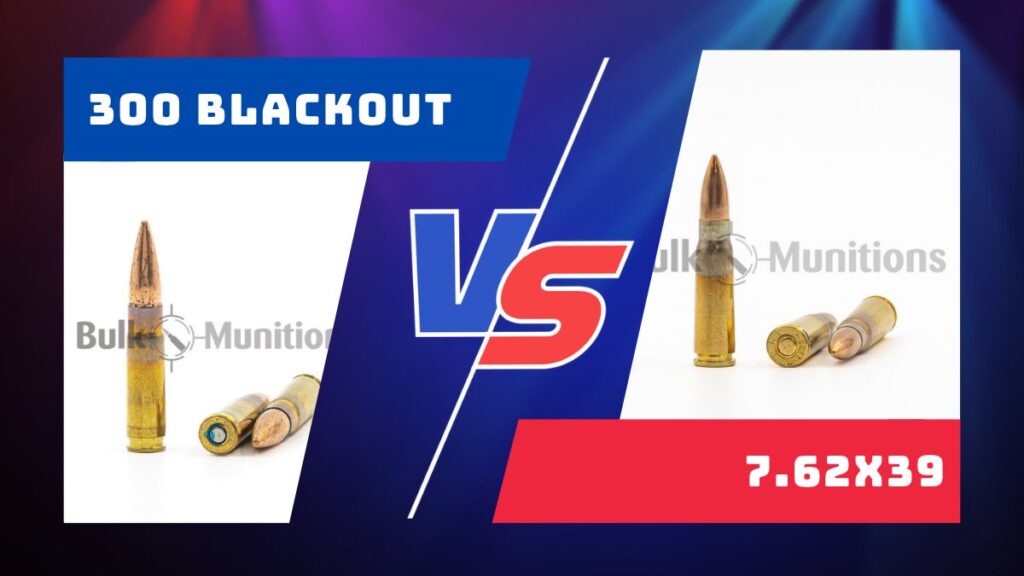
The 300 AAC Blackout and the 7.62x39mm are both 30 caliber intermediate cartridges built for short to medium range. On paper, their supersonic loads look almost identical. In practice, they live in very different worlds. One was designed to make the AR-15 a quiet, hard-hitting 30 caliber. The other has powered the AK and SKS for more than 75 years.
If you are deciding which one to buy into, the right answer depends on your rifle, whether you shoot suppressed, and how much you want to spend per trigger pull.
Short answer: Choose 300 Blackout if you shoot an AR-15, use a suppressor or want subsonic loads. Choose 7.62×39 if you shoot an AK or SKS, or want the lowest cost per round for high-volume plinking.
300 Blackout vs 7.62×39 at a Glance
| 300 AAC Blackout | 7.62x39mm | |
|---|---|---|
| Introduced | 2011 (SAAMI standardized) | 1940s (Soviet Union) |
| Bullet diameter | .308 in | .311 to .312 in |
| Case length | 1.368 in | 1.524 in |
| Max pressure (SAAMI) | 55,000 psi | 45,000 psi |
| Common bullet weights | 110 to 125 gr supersonic, 190 to 220 gr subsonic | 122 to 125 gr, some 150 to 154 gr |
| Native platform | AR-15 (barrel swap) | AK-47/AKM, SKS |
| Suppressor performance | Excellent | Fair |
| Typical case material | Brass | Steel or brass |
Where They Came From
The 7.62x39mm was developed in the Soviet Union during World War II and was first fielded in the SKS carbine before becoming the round of the AK-47. It was designed to give infantry a lighter round than a full-power rifle cartridge, with enough punch out to a few hundred yards. Because so many AK and SKS rifles were built worldwide, 7.62×39 became one of the most produced rifle cartridges in history.
The 300 Blackout came much later. Advanced Armament Corp. developed it around 2010 to give the AR-15 a 30 caliber round that could use the standard bolt and magazines, perform well from short barrels, and run heavy subsonic bullets quietly through a suppressor. SAAMI standardized it in 2011, and it took off with AR builders, hunters and suppressor owners.
Ballistics
| Load | Velocity (16 in barrel) | Muzzle energy |
|---|---|---|
| 300 BLK 110 gr supersonic | About 2,350 fps | About 1,350 ft-lbs |
| 300 BLK 125 gr supersonic | About 2,215 fps | About 1,360 ft-lbs |
| 300 BLK 220 gr subsonic | About 1,000 fps | About 490 ft-lbs |
| 7.62×39 123 gr FMJ | About 2,350 fps | About 1,510 ft-lbs |
Ballistic figures are typical factory numbers for common loads. Your results will vary with the exact load, barrel length and conditions. Energy is calculated from the listed bullet weight and velocity.
With supersonic loads, the two rounds perform very similarly. Common 123 grain 7.62×39 loads carry a little more energy at the muzzle than common 125 grain 300 Blackout loads. Both drop significantly past 300 yards, and both are best thought of as 200 to 300 yard cartridges.
The 300 Blackout’s big advantage is flexibility. It can run light, fast bullets for hunting or heavy subsonic bullets for quiet shooting. 7.62×39 has a narrower range of practical loads.
Suppressed and Subsonic Shooting
This is the main reason 300 Blackout exists. Subsonic loads travel below the speed of sound, so there is no supersonic crack. Paired with a suppressor, a 300 Blackout rifle with subsonic ammo is very quiet compared to typical rifle fire. Heavy 190 to 220 grain bullets keep the energy reasonable for close-range work, and many AR-15s cycle subsonic 300 Blackout reliably with the right gas setup.
7.62×39 can be suppressed, but supersonic loads still produce a crack, and true subsonic 7.62×39 ammo is less common and may not cycle every AK reliably.
Platforms
300 Blackout
Most AR-15 owners can switch to 300 Blackout by swapping the barrel or the whole upper. The bolt, buffer, lower and standard magazines usually stay the same. It is also available in bolt-action rifles, pistols and AR-pattern SBRs.
7.62×39
The AK and SKS are built around it, and both are famous for reliability. 7.62×39 also shows up in the Ruger Mini-30, CZ 527 and other bolt guns. It can run in an AR-15, but the case is wider and more tapered, so you need a dedicated bolt and curved 7.62×39 magazines for reliable feeding.
Hunting
Both cartridges can take deer and hogs at moderate ranges with the right bullets. Use expanding soft point or polymer-tip bullets, not FMJ. 300 Blackout has more purpose-built hunting loads, such as 110 and 120 grain expanding bullets designed to open up at its lower velocities. 7.62×39 soft points are also widely used for deer and hogs inside 150 to 200 yards. Always check your state’s caliber and bullet rules.
Home Defense
Both will work, but consider overpenetration through walls with any rifle round. 300 Blackout from a short-barreled AR with a suppressor is a popular home defense setup because it is quieter indoors. Choose defensive loads designed to expand.
Important Safety Note
Never load 300 Blackout into a 5.56 or .223 rifle. Because 300 Blackout is made from shortened 5.56 brass, it can fit in a 5.56 chamber. Firing it can blow up the rifle and seriously injure the shooter. Mark 300 Blackout magazines clearly, keep the ammo separate, and consider colored mags or tape for anything 300 Blackout.
Cost per Round
| 300 Blackout | 7.62×39 | |
|---|---|---|
| Lowest price per round in stock | About $0.89 | About $0.69 |
| Typical range | $0.89 to $2.12 | $0.69 to $1.37 |
Prices are BulkMunitions in-stock prices at the time of writing (November 2026) and change often. Check the category page for current pricing.
7.62×39 is usually the budget choice, especially steel-cased range ammo. 300 Blackout costs more, but brass cases mean it is reloadable, and you get far more load options.
Pros and Cons
300 Blackout
- Pro: runs in an AR-15 with a barrel swap
- Pro: excellent with a suppressor
- Pro: supersonic and subsonic options
- Pro: performs well from short barrels
- Con: higher cost per round
- Con: can be mistakenly loaded into a 5.56 rifle
7.62×39
- Pro: low-cost steel-cased ammo
- Pro: works in rugged AK and SKS rifles
- Pro: slightly more energy with common loads
- Con: limited subsonic options
- Con: needs special bolt and mags in an AR
- Con: steel cases are not reloadable
Which Should You Choose?
- You own an AR-15 and want 30 caliber: 300 Blackout.
- You own or want a suppressor: 300 Blackout.
- You own an AK or SKS: 7.62×39.
- You want the cheapest high-volume plinking: 7.62×39.
- You want one short rifle for hogs and deer: either works with the right expanding bullets.
Shop 300 Blackout ammo or 7.62×39 ammo in bulk.
FAQ
Is 300 Blackout the same as 7.62×39?
No. They fire similar 30 caliber bullets, but the cases are different and they are not interchangeable.
Which hits harder?
With common supersonic loads, 7.62×39 has a small energy edge at the muzzle. With heavy subsonic loads, 300 Blackout trades energy for quiet.
Can an AR-15 shoot 7.62×39?
Yes, with a 7.62×39 barrel, the correct bolt and dedicated 7.62×39 magazines.
Can I use regular AR-15 magazines for 300 Blackout?
Usually yes. Most standard AR-15 magazines feed 300 Blackout, though some heavy subsonic loads feed best from mags made for 300 Blackout.
Is 300 Blackout good for deer?
Yes, at moderate ranges with expanding bullets designed for its velocity. Check your state’s hunting rules.
Is steel-cased 7.62×39 bad for my rifle?
AKs and SKSs are built to run it. Steel cases are not reloadable, and some shooters see faster extractor wear in other platforms.
Why is 300 Blackout more expensive?
It is a newer cartridge with mostly brass-cased loads and no large surplus supply.