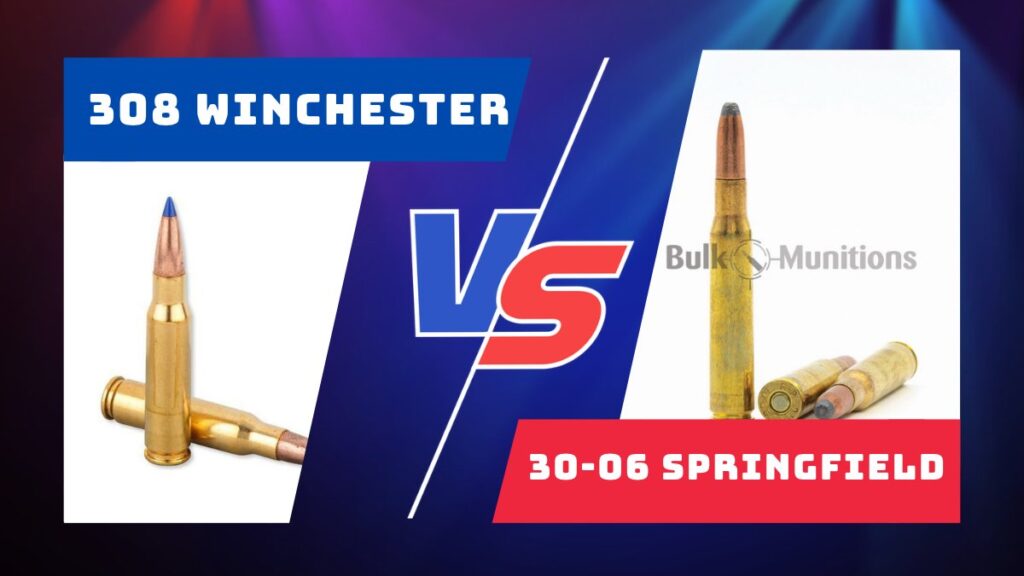
The .308 Winchester and the 30-06 Springfield are two of the best-selling rifle cartridges in America, and they have been arguing for the same spot in the gun safe for more than 70 years. Both fire the same .308 inch bullet. Both have deep military roots. Both will cleanly take any big game animal in North America when you do your part. So why do hunters and shooters still debate them?
Because the small differences add up depending on what you shoot, where you hunt and what kind of rifle you want to carry. This guide walks through history, ballistics, recoil, rifles, bullet choices and cost so you can pick the right one.
Short answer: Pick the .308 if you want a lighter, handier rifle, less recoil, more match ammo and semi-auto options. Pick the 30-06 if you want a little more speed and power, especially with heavy bullets for elk and moose, or if you shoot an M1 Garand.
308 vs 30-06 at a Glance
| .308 Winchester | 30-06 Springfield | |
|---|---|---|
| Introduced | 1952 (commercial) | 1906 (U.S. military) |
| Military counterpart | 7.62x51mm NATO | Cal. .30 M2 Ball |
| Bullet diameter | .308 in | .308 in |
| Case length | 2.015 in | 2.494 in |
| Max overall length | 2.810 in | 3.340 in |
| Rifle action | Short action | Long (standard) action |
| Max pressure (SAAMI) | 62,000 psi | 60,000 psi |
| Common bullet weights | 125 to 180 gr | 125 to 220 gr |
| Felt recoil | Moderate | Moderate to stout |
History: From the Trenches to the Deer Woods
The 30-06 gets its name from the caliber (.30) and the year it was adopted by the U.S. Army (1906). It was the standard American service round through both World Wars and Korea, fired from the M1903 Springfield, the M1 Garand, the BAR and the M1919 machine gun. Millions of soldiers came home familiar with it, and for most of the 20th century it was the default American big game cartridge.
By the late 1940s, the military wanted a shorter round that could match the 30-06’s performance in a lighter rifle. Improvements in powder made that possible. The result was the T65 experimental cartridge, which became the 7.62x51mm NATO. Winchester released the commercial version as the .308 Winchester in 1952, two years before NATO adopted the military round.
The .308 caught on fast. It fit in short-action rifles, it was accurate, and it delivered nearly the same performance as the 30-06 with less powder and less recoil. Today it is one of the most popular centerfire rifle cartridges in the world, and the 30-06 remains a favorite for hunters who value its extra reach with heavy bullets.
Cartridge Design
The most visible difference is length. The 30-06 case is about half an inch longer than the .308. That extra room holds more powder, which is where the 30-06 gets its velocity edge, and it allows longer, heavier bullets to be seated without eating into powder space.
The shorter .308 fits a short action. That means a shorter bolt throw, a slightly lighter and stiffer receiver, and a rifle that is often an inch or so shorter overall. Many shooters feel that short actions are a little faster to cycle and a little more rigid, which can help accuracy.
Ballistics: Velocity and Energy
With the same bullet weight, the 30-06 usually runs about 75 to 150 feet per second faster than the .308 out of a typical 22 to 24 inch barrel. Here is how common factory loads compare at the muzzle:
| Load | .308 Winchester | 30-06 Springfield |
|---|---|---|
| 150 gr | About 2,820 fps / 2,650 ft-lbs | About 2,910 fps / 2,820 ft-lbs |
| 165 gr | About 2,700 fps / 2,670 ft-lbs | About 2,800 fps / 2,870 ft-lbs |
| 180 gr | About 2,620 fps / 2,740 ft-lbs | About 2,700 fps / 2,910 ft-lbs |
| 200 to 220 gr | Rare | Available from several makers |
Ballistic figures are typical factory numbers for common loads. Your results will vary with the exact load, barrel length and conditions. Energy is calculated from the listed bullet weight and velocity.
What does that mean in the field? With the same bullet, the 30-06 shoots a little flatter and hits a little harder, but the gap is small. Out to 300 yards, the difference in drop between the two is usually just a couple of inches. Past 400 yards, the 30-06’s extra speed helps a bit more, but at that distance your wind reading and practice matter far more than which cartridge you chose.
The bigger advantage for the 30-06 is at the heavy end. Its longer case handles 200 and 220 grain bullets well, which give deep penetration on elk, moose and bears. The .308 can shoot heavy bullets too, but they take up more of its powder space and velocity drops off.
Recoil
The .308 kicks less. In an 8 pound rifle, common 150 grain .308 loads produce roughly 15 to 17 ft-lbs of free recoil energy, while comparable 30-06 loads produce roughly 17 to 20 ft-lbs. Move to 180 grain bullets and the 30-06 gets into the low 20s.
That difference sounds small on paper, but it matters if you are recoil sensitive, shooting a light mountain rifle, or putting a lot of rounds downrange at the bench. Less recoil usually means better shooting, especially for newer hunters.
Rifles and Platforms
.308 Winchester
- Short-action bolt guns from nearly every maker, including Remington 700, Savage 110, Ruger American, Tikka T3x, Bergara and Howa
- Semi-autos such as AR-10 pattern rifles, the M1A/M14, FN FAL and SCAR 17
- Precision and tactical rifles built for long-range competition
- Lever actions such as the Browning BLR and some Henry models
30-06 Springfield
- Long-action bolt guns, including classics like the Winchester Model 70 and Remington 700
- The M1 Garand, plus the M1903 Springfield and other military surplus rifles
- Semi-auto hunting rifles such as the Browning BAR
- Pump actions such as the Remington 7600
M1 Garand owners take note: the Garand’s gas system was designed around specific pressure levels. Use ammo labeled as safe for the M1 Garand, or a gas plug made for commercial loads, to avoid damaging the operating rod.
Hunting Performance
| Game | .308 Winchester | 30-06 Springfield |
|---|---|---|
| Whitetail and mule deer | Excellent | Excellent |
| Hogs | Excellent | Excellent |
| Black bear | Very good | Very good |
| Elk | Good with quality 165 to 180 gr bullets inside reasonable range | Very good, especially with 180 to 200 gr bullets |
| Moose | Adequate with premium bullets and good shot placement | Good with 180 to 220 gr bullets |
For deer and hogs, there is no practical difference. For bigger animals, the 30-06 gives you a little more margin, mostly because of the heavier bullets it handles well. Either way, bullet construction and shot placement matter more than the cartridge.
Target Shooting and Long Range
The .308 has a long history in precision rifle shooting, from Palma to F-Class T/R to police and military sniper rifles. As a result, there is a deep selection of match ammo built around bullets like the 168 and 175 grain Sierra MatchKing. The 30-06 can be very accurate, and it still shines in vintage military matches, but you will find more match-grade .308 on the shelf.
Bullet Types You Will See
- FMJ (full metal jacket): range and plinking ammo. Not for hunting.
- Soft point (SP/JSP): classic, affordable hunting bullets like Federal Power-Shok and Remington Core-Lokt.
- Polymer tip and bonded bullets: premium hunting loads that expand reliably and hold together on larger game.
- Monolithic copper: lead-free options for areas that require them, with deep penetration.
- BTHP/match: open-tip match bullets for accuracy at the range and in competition.
Cost per Round
Both cartridges are widely available. .308 usually has more bulk FMJ options thanks to the 7.62×51 surplus and range ammo market, while 30-06 is plentiful in hunting loads and Garand-safe ball ammo.
| .308 Winchester | 30-06 Springfield | |
|---|---|---|
| Lowest price per round in stock | About $0.90 | About $1.03 |
| Typical range | $0.90 to $3.19 | $1.03 to $3.19 |
Prices are BulkMunitions in-stock prices at the time of writing (November 2026) and change often. Check the category page for current pricing.
Pros and Cons
.308 Winchester
- Pro: lighter recoil
- Pro: short, handy rifles
- Pro: huge selection of match and bulk ammo
- Pro: works in semi-autos like the AR-10
- Con: less ideal for very heavy bullets
- Con: slightly less velocity than the 30-06
30-06 Springfield
- Pro: a bit more speed and energy
- Pro: handles 200 to 220 gr bullets well
- Pro: legendary history and the M1 Garand
- Con: more recoil
- Con: longer, heavier rifles
- Con: fewer match and semi-auto options
Which Should You Choose?
- First deer rifle: .308. Less recoil helps new hunters shoot better.
- Elk or moose in big country: 30-06 with 180 to 200 gr bullets, or a .308 with premium bullets if you keep shots reasonable.
- Long-range target shooting: .308 for its match ammo selection.
- Semi-auto battle rifle or AR-10: .308.
- M1 Garand or vintage military matches: 30-06.
- You already own one: keep shooting it. Neither will hold you back.
Ready to stock up? Shop .308 Winchester ammo or 30-06 Springfield ammo in bulk, in stock and shipped fast.
FAQ
Is 30-06 more powerful than 308?
Slightly. With the same bullet, the 30-06 is usually about 100 fps faster and carries roughly 150 to 200 ft-lbs more energy at the muzzle. It also handles heavier bullets better.
Can you shoot 308 in a 30-06 rifle?
No. They are different cartridges with different case lengths. Firing the wrong cartridge can be dangerous. Only shoot the cartridge stamped on your barrel.
Is 308 or 30-06 better for deer?
Both are excellent. Many hunters prefer the .308 because it has a little less recoil and comes in shorter, lighter rifles.
Is 308 or 30-06 better for elk?
The 30-06 has a small edge thanks to heavier bullets, but a .308 with quality 165 to 180 gr bullets works well at sensible ranges.
Is 308 the same as 7.62×51 NATO?
They are very close but not identical, and pressure specs and chamber dimensions differ slightly. Most modern .308 rifles handle 7.62 NATO, but check your rifle maker’s guidance before mixing them.
Which is more accurate?
Both are capable of excellent accuracy. The .308 has more match ammo available and a short action, which is why it dominates precision shooting.
Which has less recoil?
The .308, by about 10 to 20 percent with similar bullet weights.
Which is cheaper to shoot?
They are close. The .308 usually has more low-cost bulk FMJ options.